
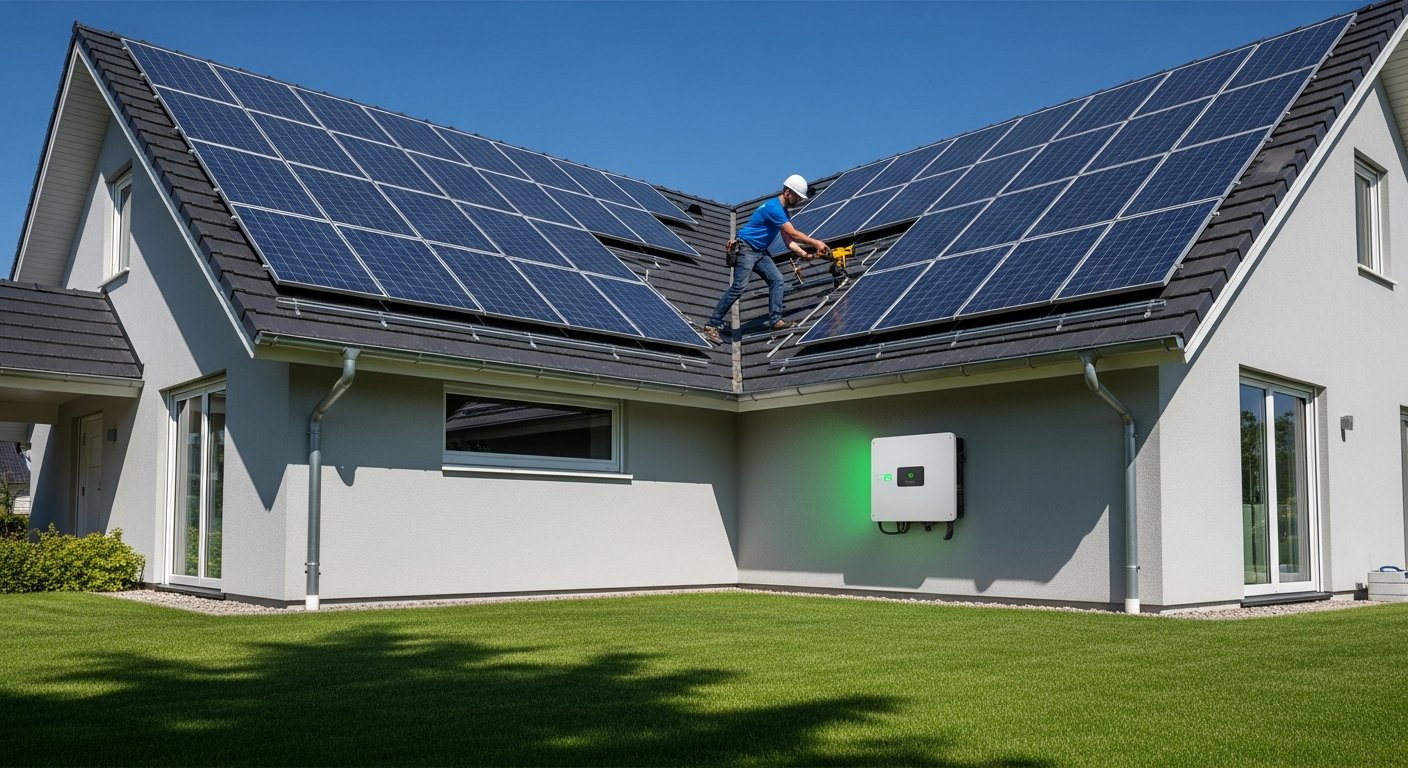
What Is Solar Energy and How Does It Power Your Home
Solar energy converts sunlight into electricity, cutting bills and carbon emissions. Learn how panels work and what they can save you.
By Scott Thompson
Learn more about Solar Panel Installation and Repair for guides, costs, and what to expect.
Compare Solar Panel Installation and Repair Pros Near You
Enter your ZIP code to compare top-rated local professionals and request free quotes.
Every hour, the sun delivers more energy to Earth than the entire human population uses in a year. That single fact explains why solar energy has become the fastest-growing source of electricity in the United States. But what is solar energy exactly, and how can a homeowner or business owner turn sunlight into savings? This article breaks down the science, the technology, and the practical steps to harness the sun's power for your own property.
Defining Solar Energy: The Basics
Solar energy is the radiant light and heat emitted by the sun. It is a renewable resource, meaning it will not run out on any human timescale. Unlike fossil fuels such as coal, oil, and natural gas, solar energy produces no greenhouse gases during operation. This makes it a cornerstone of efforts to reduce carbon emissions and combat climate change.
At its simplest, solar energy can be used in two ways: to generate electricity or to produce heat. Photovoltaic (PV) panels convert sunlight directly into electricity. Solar thermal systems capture sunlight to heat water or air for residential or commercial use. Both technologies rely on the same abundant source: the sun.
The amount of solar energy that reaches the Earth's surface is enormous. According to the U.S. Department of Energy, enough sunlight falls on the United States in one hour to power the entire country's electricity needs for a full year. The challenge has always been capturing that energy efficiently and affordably. Thanks to decades of innovation, solar panels today are far more efficient and much less expensive than they were just ten years ago. The cost of solar photovoltaic panels has dropped by more than 70 percent since 2010, making solar energy accessible to millions of homeowners.
How Solar Panels Convert Sunlight into Electricity
Understanding what is solar energy in practical terms requires a look inside a solar panel. A typical solar panel is made up of many individual solar cells, which are usually made from silicon. When sunlight hits these cells, it knocks electrons loose from their atoms. This flow of electrons creates direct current (DC) electricity.
Most homes and businesses in the United States use alternating current (AC) electricity. This is where a device called an inverter comes in. The inverter converts the DC electricity generated by your solar panels into AC electricity that your appliances, lights, and electronics can use. Modern systems often use microinverters or power optimizers attached to each panel, which can improve overall system efficiency and allow for better monitoring of individual panel performance.
The process can be broken down into a few clear steps:
- Sunlight hits the solar panels. Photons from the sun strike the silicon cells, causing electrons to move and generate DC electricity.
- The inverter converts the electricity. DC power flows to the inverter, which transforms it into usable AC power.
- Electricity powers your home. The AC electricity travels to your main electrical panel, where it is distributed to lights, appliances, and devices throughout the building.
- Excess energy goes to the grid or a battery. If your system produces more electricity than you use, the surplus can be sent to the utility grid (earning you credits through net metering) or stored in a solar battery for later use.
This entire process happens silently and automatically. There are no moving parts in the solar panels themselves, which is one reason they require very little maintenance. Many manufacturers offer warranties of 25 years or more on their panels, and the systems often continue producing electricity well beyond that period.
Net Metering: How You Get Paid for Extra Power
Net metering is one of the most important financial incentives for going solar. Under a net metering policy, your utility company credits you for any excess electricity your solar panels send back to the grid. When your panels are producing more power than your home is using (for example, during a sunny midday when you are at work), the meter runs backward. You effectively store those kilowatt-hours as credits on your account.
At night or on cloudy days, when your panels produce less electricity than you need, you draw power from the grid and use those credits to offset the cost. Net metering policies vary by state and by utility. Some states have strong net metering laws that guarantee full retail credit for every kilowatt-hour you send to the grid. Others have moved to net billing or time-of-use rates that offer lower compensation. Before installing solar, it is wise to check your local utility's net metering policy and understand how it will affect your overall savings.
The Financial Benefits of Switching to Solar
For most homeowners, the decision to install solar panels comes down to money. The question is not just what is solar energy in a scientific sense but what it can do for your household budget. The answer is significant. A properly sized solar system can reduce or even eliminate your monthly electricity bill, protecting you from rising utility rates for decades.
The federal solar investment tax credit (ITC) currently allows you to deduct 30 percent of the cost of your solar system from your federal taxes. This is a dollar-for-dollar reduction of the taxes you owe, not just a deduction. For a typical residential system costing $20,000, the ITC would save you $6,000. Many states and local utilities offer additional rebates, performance-based incentives, or property tax exemptions that further reduce the upfront cost.
Beyond direct savings, solar panels increase your home's resale value. Multiple studies have shown that homes with solar panels sell for a premium compared to similar homes without solar. One study by Zillow found that homes with solar panels sold for 4.1 percent more on average. In a competitive housing market, that premium can amount to tens of thousands of dollars. Buyers are willing to pay more because they know they will enjoy lower utility costs from day one.
Financing Options to Fit Your Budget
You do not need to pay for a solar system in cash. There are several financing options that make solar accessible to almost any homeowner:
- Solar loans: These are specialized loans designed for solar installations. They often have low interest rates and allow you to own the system from the start, which means you qualify for the federal tax credit and any state incentives.
- Solar leases and power purchase agreements (PPAs): With a lease or PPA, a third party owns the solar panels on your roof. You pay a fixed monthly lease payment or a per-kilowatt-hour rate for the electricity the panels produce. You do not own the system, so the tax credits go to the third party, but you can still save money on your electricity bills with little or no upfront cost.
- Home equity loans or lines of credit: Some homeowners use home equity financing to pay for solar. This can offer competitive interest rates and the interest may be tax-deductible.
Each option has its pros and cons. Owning your system outright (whether through cash or a loan) typically gives you the highest long-term savings because you capture all the incentives and the full value of the electricity produced. Leasing offers simplicity and lower upfront costs but generally results in lower total savings over the life of the system.
Environmental Impact and Energy Independence
Solar energy is one of the cleanest sources of electricity available. A typical residential solar system offsets roughly three to four tons of carbon dioxide emissions each year. Over the 25-year life of the system, that is the equivalent of planting more than 100 trees or taking a car off the road for several years. For homeowners who care about their carbon footprint, solar offers a tangible way to make a difference.
Energy independence is another powerful motivator. When you generate your own electricity, you are less vulnerable to utility rate hikes, grid outages, and fuel price volatility. Adding a solar battery, such as a Tesla Powerwall or LG Chem RESU, can provide backup power during blackouts and allow you to store excess solar energy for use at night. For many homeowners, the peace of mind that comes from energy independence is just as valuable as the financial savings.
Is Solar Right for Your Home?
Not every home is an ideal candidate for solar panels, but most are. The most important factors to consider are your roof's orientation, shading, and condition, as well as your local climate and electricity rates.
In the northern hemisphere, south-facing roofs receive the most direct sunlight and produce the most electricity. East- and west-facing roofs can also work well, though they produce slightly less energy. If your roof is heavily shaded by trees or nearby buildings, you may still be able to go solar, but your system will need to be larger to compensate for the reduced sunlight. A professional solar installer can conduct a site assessment to estimate your home's solar potential accurately.
Your electricity usage also matters. If your monthly electric bill is relatively low (say, under $75), the financial case for solar may be weaker. However, if you pay high rates or use a lot of electricity (for example, if you own an electric vehicle or have a pool pump), solar can deliver substantial savings. The best way to know for sure is to get personalized quotes from multiple certified installers. NewSolarQuotes can connect you with vetted professionals who will evaluate your specific situation and provide a detailed cost and savings estimate.
State and Regional Incentives
Solar incentives vary widely by location. Some states, like California and New York, offer generous state tax credits and rebates. Others, like Florida and Texas, have strong net metering policies but no state-level tax credit. Arizona and Colorado offer a mix of utility rebates and property tax exemptions. It is essential to research the incentives available in your state and municipality before making a decision. Many incentives have caps on the total amount or are available only until a certain date, so acting promptly can maximize your savings.
NewSolarQuotes provides state-specific guides that break down the incentives, regulations, and average installation costs in your area. These guides are regularly updated to reflect changes in policy, so you can rely on them for accurate information.
Choosing the Right Solar Equipment
Not all solar panels are created equal. Panels vary in efficiency, durability, and cost. The most common types are monocrystalline, polycrystalline, and thin-film. Monocrystalline panels are the most efficient and the most popular for residential installations. They perform well in low-light conditions and have a sleek, uniform appearance. Polycrystalline panels are slightly less efficient but also less expensive. Thin-film panels are the least efficient but can be flexible and lightweight, making them suitable for certain applications.
Inverters are another critical component. As mentioned earlier, microinverters and power optimizers can improve system performance, especially on roofs that have some shading or multiple orientations. String inverters, which connect all panels in a series, are simpler and less expensive but can reduce overall output if one panel underperforms.
Solar batteries are becoming increasingly popular as battery prices fall and as more utilities move to time-of-use rate structures. A battery allows you to store excess solar energy during the day and use it during peak evening hours when electricity is most expensive. It also provides backup power during outages. The two most popular battery options as of 2026 are lithium-ion and lithium iron phosphate (LFP). LFP batteries are slightly less energy-dense but offer longer cycle life and better safety characteristics.
When evaluating equipment, look for panels and inverters that are certified by Underwriters Laboratories (UL) and that carry strong manufacturer warranties. A typical panel warranty covers 25 years for power output and 10 to 12 years for materials and workmanship. Inverters usually have warranties of 10 to 12 years, though some manufacturers offer extended warranties for an additional cost.
The Installation Process: What to Expect
Once you decide to go solar, the installation process typically takes one to three days, depending on the size of the system and the complexity of your roof. Before installation begins, your installer will obtain the necessary permits from your local building department and your utility company. This permitting process can take anywhere from a few days to several weeks, depending on your location and the workload of local permitting offices.
On installation day, the crew will first set up scaffolding and safety equipment. They will then mount racking hardware to your roof, attach the solar panels to the racking, and run conduit to connect the panels to the inverter and your main electrical panel. After the physical installation is complete, the system must be inspected by your local building department and approved by your utility company before it can be turned on. This final step, called interconnection, can take a few days to a few weeks.
After interconnection, your system will start generating electricity immediately. Most systems come with monitoring software that lets you track your energy production in real time on your smartphone or computer. If you notice a sudden drop in production, it may indicate a problem with a panel or inverter, and you should contact your installer or monitoring service provider.
Maintenance and Longevity
Solar panels require very little maintenance. Rain typically washes away most dust and dirt, but in dry climates or areas with heavy pollen, you may need to hose off the panels once or twice a year. Avoid using abrasive cleaners or high-pressure washers, as these can damage the panels. If your panels are installed at a steep angle, they may self-clean more effectively. Snow usually slides off angled panels as it melts, but in heavy snow areas, you can use a soft roof rake to clear accumulated snow.
Most solar panels are designed to withstand hail, high winds, and extreme temperatures. They are tested to meet rigorous industry standards for durability. In the unlikely event that a panel is damaged, it can usually be replaced individually without affecting the rest of the system. Inverters and batteries may need to be replaced once during the life of the system, typically after 10 to 15 years. Budgeting for these replacements is part of a realistic long-term solar ownership plan.
Solar energy is a proven, reliable technology that can save you money, reduce your environmental impact, and give you greater control over your energy future. Whether you are motivated by financial savings, energy independence, or environmental stewardship, solar offers a clear path forward. The key is to start with accurate information and trusted partners. Visit NewSolarQuotes to compare quotes from certified installers in your area and take the first step toward powering your home with the sun.
Learn more about Solar Panel Installation and Repair for guides, costs, and what to expect.
Compare Solar Panel Installation and Repair Pros Near You
Enter your ZIP code to compare top-rated local professionals and request free quotes.