
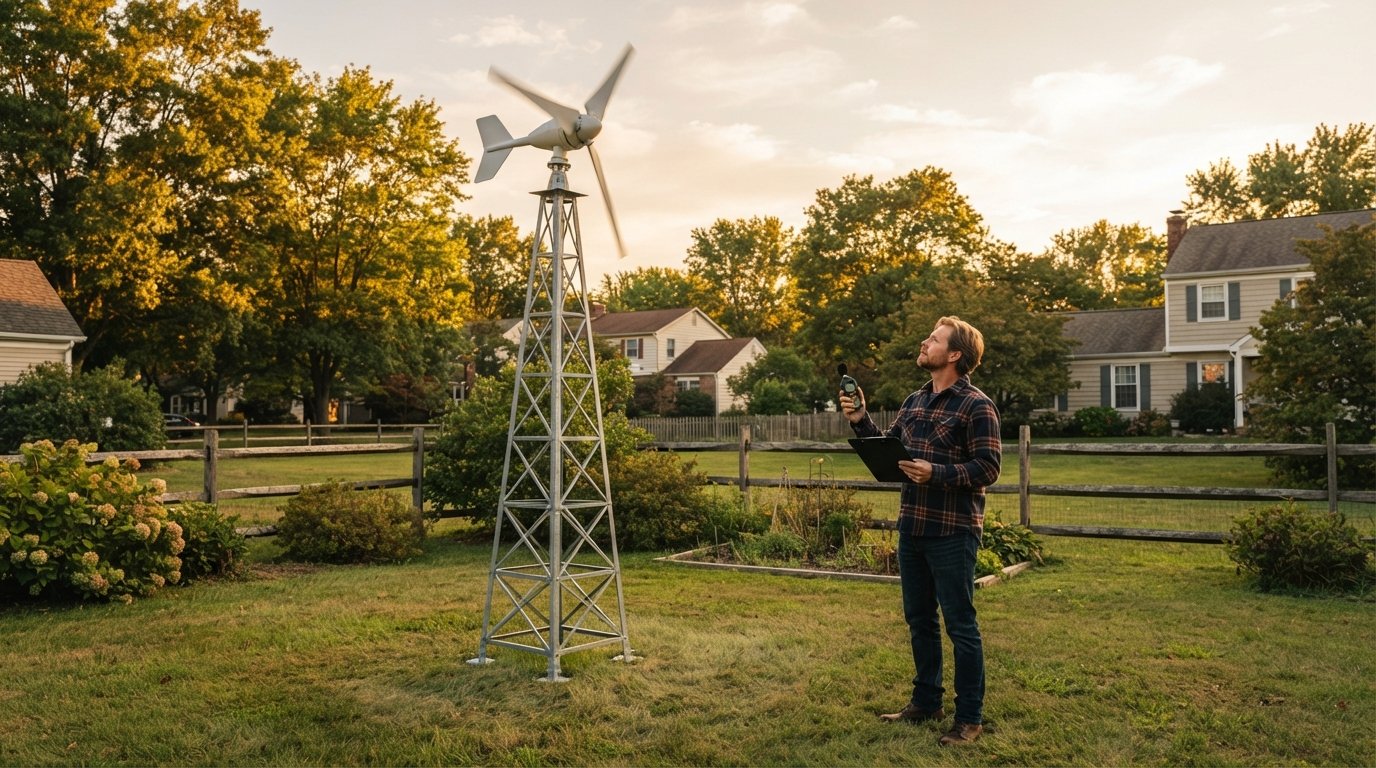
Residential Wind Turbine Noise and Zoning Concerns
Residential wind turbine noise and zoning concerns explained, from decibel limits to setback rules. Call (833)-212-3715 for help comparing clean energy options.

By Alex Carter
Learn more about Solar Panel Installation and Repair for guides, costs, and what to expect.
Compare Solar Panel Installation and Repair Pros Near You

Enter your ZIP code to compare top-rated local professionals and request free quotes.
You have compared solar quotes, mapped your roof, and maybe even looked at battery storage. But a wind turbine on your property can produce power around the clock, and that is exactly why the noise question and the zoning question come up before anything else. The reality is that a small residential turbine is not a silent appliance, and your local code may limit where it can stand, how tall it can be, and how far it must sit from your neighbor's bedroom window. This article walks through the decibel data, the setback and height rules that show up again and again in residential zoning codes, the neighbor objections that stall permits, and how to decide whether wind belongs alongside or instead of solar.
How Loud Is a Small Wind Turbine, Really?
Decibel numbers get thrown around loosely, so it helps to anchor them to sounds you already know. A quiet suburban street at night sits around 35 to 40 dBA. A refrigerator hum is roughly 40 dBA. Normal conversation is about 60 dBA. Most small residential turbines in the 1 kW to 10 kW range are rated in the 35 to 55 dBA range at a reference distance, though manufacturers measure differently and some report sound power rather than sound pressure at a specific distance. That distinction matters: a turbine rated at 45 dBA at 10 meters will read lower at 30 meters, and lower still at 60 meters, because sound drops roughly 6 dB each time you double the distance in open air.
The more important point is that wind turbine noise is not a single steady tone. It has three components that neighbors notice separately. First, there is the broadband whoosh from the blades passing the tower, which rises and falls in a rhythmic pattern. Second, there is mechanical noise from the generator and gearbox, which is usually minor on modern small turbines but can become audible when bearings wear. Third, there is tonal noise, a faint whine at a specific frequency that travels farther than broadband sound and is the complaint most likely to trigger a zoning violation. Low-frequency sound below 200 Hz is also a recurring objection, though the scientific literature on health effects at residential exposure levels remains contested.
Background noise masks turbine sound more than most people expect. A turbine that is barely audible on a still night can disappear entirely when wind is moving the trees, because wind in foliage generates its own broadband noise in the same frequency range. This is why noise complaints often peak on calm evenings when the turbine is still turning slowly, and why a 45 dBA turbine next to a busy road may never be noticed while the same turbine on a quiet rural lot becomes a nightly irritant. If you want to estimate real-world impact, measure background dBA at the property line during your quietest expected hour, then compare that to the manufacturer's sound pressure level at your actual setback distance.
Zoning Codes: Setbacks, Height Limits, and the Rules That Trip People Up
Residential wind zoning is a patchwork. Some municipalities have a dedicated small wind ordinance with clear tables. Others have no wind-specific language at all and force your project through a conditional use permit or variance process, which means planning commission hearings, neighbor notification letters, and months of uncertainty. Before you buy anything, call your local planning department and ask three questions: is small wind an allowed use in my zone, what is the maximum tower height, and what setback applies. The answers will shape whether wind is even feasible on your lot.
Setbacks are the most common dealbreaker. A typical residential ordinance requires the tower to be set back from property lines by a distance equal to 1 to 1.5 times the total tower height, including the rotor radius. On a quarter-acre lot, that math frequently rules out a turbine entirely, because a 60-foot tower with a 12-foot rotor radius needs roughly 72 to 108 feet of clearance from the nearest property line. Height limits are the second trap. Many residential districts cap structures at 35 feet, and a wind turbine that height will produce very little useful power because wind speed increases with altitude. Some codes grant an exception for wind energy conversion systems, but you have to request it explicitly.
Here are the zoning provisions that most often determine whether a residential turbine gets approved:
- Setback from property lines: commonly 1 to 1.5 times total height, sometimes measured to the nearest inhabited structure instead.
- Maximum total height: often 35 to 80 feet in residential zones, with taller towers requiring a variance or conditional use permit.
- Noise limits at the property line: frequently 45 to 55 dBA during the day and 5 to 10 dB lower at night, sometimes with a separate low-frequency penalty.
- Flicker and shadow provisions: some codes limit shadow flicker on neighboring homes to a set number of hours per year.
- Decommissioning and insurance requirements: a bond or proof of liability coverage is increasingly common, especially for towers over 40 feet.
Notice that noise limits are usually written as property-line standards, not as a limit at your own house. That means your neighbor's porch, not your kitchen, is the measuring point. If your lot is small or your neighbor's house sits close to the line, a turbine that sounds perfectly reasonable to you can still fail the code. Ask the planning office how they measure compliance, whether they use dBA or a low-frequency weighting, and whether they require a manufacturer's sound report or an independent acoustic study.
Neighbor Relations and the Permit Objections to Expect
Most residential wind projects that fail do not fail on engineering. They fail on neighbor objections raised during the public comment period. The objections follow predictable patterns, and knowing them in advance lets you address them before they harden into opposition. The most common complaints are noise, shadow flicker, ice throw, property value concerns, and visual impact on viewsheds. Shadow flicker, the strobe effect when rotor blades pass between the sun and a window, is often the single most inflammatory issue because it is intermittent, visible, and easy to photograph for a complaint file.
You can reduce friction substantially with a few deliberate steps. Talk to neighbors before you file, not after. Bring the manufacturer's sound data and a simple map showing the setback distance and the shadow path at the winter solstice. Offer to site the turbine farther from the shared property line than the code requires, and put that commitment in writing as a voluntary condition. If a neighbor has a legitimate concern about low-frequency sound or flicker, acknowledge it rather than dismissing it, because planning commissioners respond to tone as much as to data. Homeowners who treat the permit as a negotiation rather than a formality get approved far more often.
It also helps to know your state's preemption rules. A handful of states have laws limiting how far local governments can restrict small wind, but most leave zoning entirely to municipalities. If your town has no wind ordinance, you may be arguing for a variance under general structure rules, which is harder. In that situation, an acoustic consultant's report and a written neighbor support letter carry real weight. If you are still comparing renewable options and want to see how off-grid wind systems are sized before you commit to a permit fight, the guide to home wind turbines for off-grid living walks through the equipment side in detail.
When Wind Makes Sense Alongside or Instead of Solar
Wind and solar complement each other because they produce at different times. Solar peaks in the middle of the day and in summer. Small wind often produces more at night and in winter, when solar output drops. If your goal is energy independence rather than the lowest cost per kilowatt-hour, a hybrid system can smooth out the gaps and reduce battery cycling. But the economics only work in specific conditions, and pretending otherwise sets homeowners up for disappointment.
Wind is worth serious consideration when you have at least one acre, a tower height that clears nearby trees and structures by 30 feet or more, an average wind speed of 10 mph or better at hub height, and a zoning code that actually permits it. It is usually a poor fit on small suburban lots, in dense subdivisions, or anywhere the code caps height at 35 feet, because a turbine that short sits in turbulent air and produces a fraction of its rated output. Solar, by contrast, works on almost any roof and has no moving parts to generate noise complaints. For most homeowners in town, solar plus storage is the simpler path, and a professional quote comparison is the fastest way to see the numbers for your address.
If you are also planning a move and need to understand how renewable upgrades and local rules affect a sale, the relocation resources at Moving.Homes cover the practical side of transferring a home with energy improvements. For the wind decision itself, run the numbers before the paperwork: estimate annual production from a wind resource map for your zip code, subtract the turbine and tower cost, and compare that to a solar quote for the same site. If the payback period stretches past 15 years and the zoning path is uncertain, wind is probably a hobby rather than an investment. If the site is open, the wind resource is strong, and the code is favorable, a small turbine can be a genuine complement to a solar array.
Start with the planning department, then the wind map, then the neighbors, in that order. The noise and zoning questions are answerable, but they have to be answered before you buy a tower, not after it is already in the ground.