
Solar Batteries: Lithium-Ion vs Lead-Acid for Home Use
Compare lithium-ion vs lead-acid solar batteries for home use: costs, lifespan, efficiency, and space to pick the right one for your solar system.

By Alexia Mabel
Learn more about Solar Panel Installation and Repair for guides, costs, and what to expect.
Compare Solar Panel Installation and Repair Pros Near You

Enter your ZIP code to compare top-rated local professionals and request free quotes.
When you install solar panels, you quickly realize that the sun does not shine at night. A solar battery lets you store the extra electricity your panels produce during the day, so you can power your home after dark, during outages, or when utility rates spike. But choosing the right storage technology is not a one-size-fits-all decision. The two main contenders are lithium-ion and lead-acid batteries, and each has distinct strengths and trade-offs. This guide compares the types of solar batteries lithium-ion vs lead-acid for home use, covering cost, lifespan, safety, and real-world performance, so you can make a confident choice for your energy independence.
Why Home Energy Storage Matters in 2026
More homeowners are adding batteries not just for backup, but for financial control. With time-of-use electricity plans, you can charge your battery when power is cheap (often midday with solar) and discharge it when rates are high (evening). This practice, called load shifting, can cut your electric bill by 20 to 40 percent depending on your utility. Batteries also protect you from grid instability, which has become more common with extreme weather events and aging infrastructure.
Another driver is the expansion of net metering rules. Some utilities now pay less for the excess solar power you send to the grid, or they charge demand fees. A battery lets you consume more of your own solar energy on site, reducing your reliance on the grid. For many families, a battery is also the key to keeping essential loads running during a blackout: lights, refrigerator, Wi-Fi router, and medical devices. Before you choose a battery chemistry, you need to understand how your energy use patterns and budget align with each option.
Understanding Battery Chemistries: A Simple Overview
Both lithium-ion and lead-acid batteries store electricity as direct current (DC) and release it as needed, but they do so in fundamentally different ways. Lead-acid batteries have been around since the 1850s, often used in cars and golf carts. They use lead plates and a sulfuric acid electrolyte. In solar applications, deep-cycle versions are designed to discharge slowly and recharge repeatedly. Lithium-ion batteries, first commercialized by Sony in 1991, use lithium compounds as the active material. They are lighter, more energy-dense, and have become the default choice for electric vehicles and modern home energy storage, such as the Tesla Powerwall or LG Chem RESU.
The chemistry affects everything from physical size to charging behavior. Lithium-ion batteries can be discharged deeper without damage, which means you can use more of the stored energy. Lead-acid batteries should not be discharged below 50 percent of their capacity to avoid premature failure. This difference alone changes the usable capacity you need to buy. Additionally, lithium-ion batteries charge faster and have a higher round-trip efficiency (around 90 to 95 percent) versus lead-acid (around 75 to 85 percent). That means less energy is wasted in the charge-discharge cycle, which directly translates to more usable power from each kilowatt-hour of solar generation.
Key Differences Between Lithium-Ion and Lead-Acid
To decide between the two, you need to compare them across several dimensions. The following list breaks down the most important factors for a home solar energy system.
- Depth of Discharge (DoD): Lithium-ion can be discharged up to 90 to 95 percent, while lead-acid should only be discharged to 50 percent. This affects how many amp-hours you actually can use.
- Cycle Life: Lithium-ion typically lasts 5,000 to 10,000 cycles (10 to 15 years), while lead-acid lasts 300 to 1,500 cycles (3 to 7 years) depending on maintenance.
- Energy Density: Lithium-ion is much lighter and smaller for the same storage capacity, making wall-mounted installation easy. Lead-acid is heavy and often requires a ventilated, floor-standing battery room.
- Efficiency: Lithium-ion has 90 to 95 percent round-trip efficiency, while lead-acid is 75 to 85 percent. More of your solar energy makes it to your appliances.
- Safety and Maintenance: Lithium-ion is sealed and maintenance-free, but requires a battery management system. Lead-acid (flooded type) needs regular water refilling and ventilation to prevent hydrogen gas buildup.
These differences explain why lithium-ion dominates the residential storage market today, but lead-acid is still used in off-grid cabins and budget-conscious installations. The right choice depends on how long you plan to stay in your home, how much weight your floor can support, and whether you are willing to perform routine maintenance.
Lifespan and Warranty: The Long-Term Cost
Lifespan is not just about years; it is about total energy throughput. A lithium-ion battery that can cycle 6,000 times at 90 percent DoD will deliver far more total energy over its life than a lead-acid battery that only cycles 800 times at 50 percent DoD. For example, a 10 kWh lithium-ion battery might provide about 10,000 kWh of total throughput over its life, whereas a comparable lead-acid bank with the same nominal capacity might only provide 4,000 to 5,000 kWh because you cannot discharge it as deeply. When you divide the upfront cost by the total usable energy, lithium-ion often ends up cheaper per kilowatt-hour over the system's life, despite a higher purchase price.
Warranties also differ significantly. Most reputable lithium-ion batteries come with a 10-year warranty that guarantees a certain amount of throughput or cycles (e.g., 70 percent capacity retention after 10 years). Lead-acid batteries typically have shorter warranties, often 3 to 5 years, and they may be prorated. In practice, a lead-acid bank may need replacement twice as often as a lithium-ion system, which adds to the total cost of ownership. For homeowners who want a set-and-forget solution, lithium-ion's longer lifespan and warranty provide peace of mind that lead-acid cannot match.
Comparing Upfront Costs and Total Value
Upfront cost is the most obvious difference. As of 2026, a lithium-ion home battery (like a Tesla Powerwall or LG Chem) costs between $8,000 and $15,000 installed, depending on capacity and brand. Lead-acid batteries are cheaper to buy: a 10 kWh lead-acid bank might cost $2,000 to $4,000, but because you can only use half of its capacity, you may need double the nominal capacity to get the same usable storage. That raises the installed cost and requires more physical space. For example, to get 10 kWh of usable energy from lead-acid, you might need a 20 kWh battery bank, which could cost $4,000 to $6,000 and weigh over 1,000 pounds.
But the true value lies in the total cost per kilowatt-hour over the battery's lifetime. Lithium-ion batteries, despite their higher upfront price, often have a lower levelized cost of storage (LCOS). A study by the National Renewable Energy Laboratory found that lithium-ion systems have a 10 to 20 percent lower LCOS than lead-acid for residential solar applications, when factoring in replacement costs and efficiency losses. Add in federal tax credits (30 percent of system cost, up to 2026) and state incentives, and the net price gap narrows. For example, a $10,000 lithium-ion battery might drop to $7,000 after the federal credit, while a $4,000 lead-acid bank drops to $2,800. The lithium-ion system still costs more upfront, but it lasts longer and delivers more usable energy, so many homeowners find it is worth the investment.
Installation and Space Considerations
Physical space is a hidden constraint. Lead-acid batteries are bulky and heavy. A typical 48V 200Ah lead-acid battery weighs about 130 pounds and measures roughly 20 x 12 x 12 inches. To get 10 kWh of usable capacity, you would need four of these (for a 48V system), totaling over 500 pounds. That usually requires a reinforced floor or a dedicated battery room, plus proper ventilation to disperse hydrogen gas that can be explosive. Flooded lead-acid batteries also need to be kept upright to prevent acid spills, which limits where you can place them.
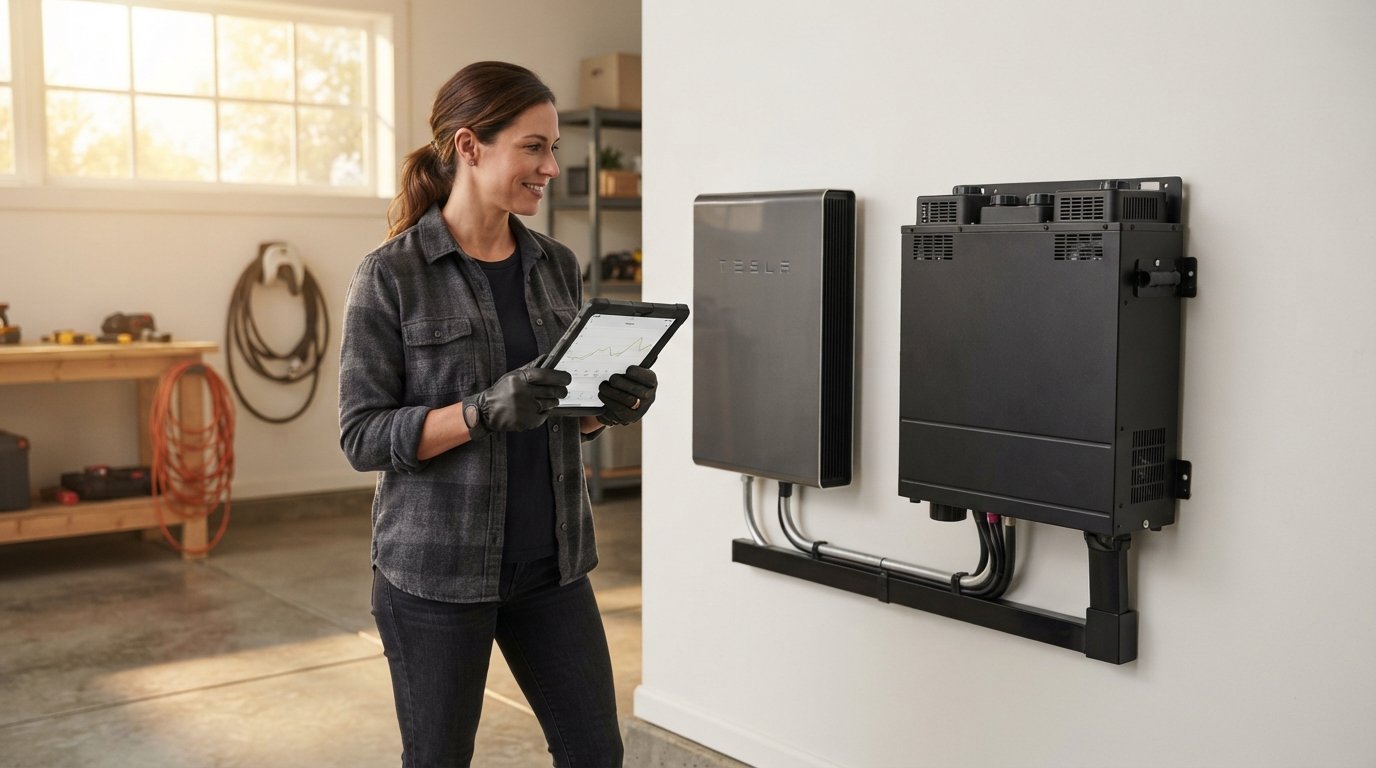
Lithium-ion batteries, in contrast, are often wall-mounted like a piece of art. The Tesla Powerwall is 45 x 29 x 6 inches and weighs about 270 pounds, but it can be installed on a garage wall or exterior wall without special flooring. They are sealed and emit no gas, so they can be placed indoors without ventilation. Many systems are modular, allowing you to stack multiple units to increase capacity. This makes lithium-ion a clear winner for most modern homes where space is at a premium, especially in garages, basements, or utility closets. If you are retrofitting a battery to an existing solar array, the compact size of lithium-ion is often the only viable option without major construction.
Maintenance and Monitoring
Maintenance is another area where the two chemistries diverge. Flooded lead-acid batteries require regular checking of electrolyte levels, adding distilled water, and cleaning terminals to prevent corrosion. You also need to perform equalization charges to balance the cells, which takes time and careful attention. Sealed lead-acid batteries (AGM or gel) require less maintenance, but they are still sensitive to overcharging and need proper charge controllers. In any case, lead-acid batteries should be kept at a partial state of charge (around 50 percent) when not in use, which is not ideal for solar systems that cycle daily.
Lithium-ion batteries are virtually maintenance-free. They come with a battery management system (BMS) that monitors cell voltage, temperature, and current, automatically balancing the cells and protecting against overcharge or over-discharge. Most modern lithium-ion home batteries connect to your Wi-Fi and provide a smartphone app that shows state of charge, energy flow, and system health in real time. This makes it easy to track your savings and see how much backup capacity you have. For homeowners who do not want to babysit their energy system, lithium-ion's plug-and-play nature is a huge advantage.
Safety and Environmental Impact
Safety is a top concern for any home battery. Lead-acid batteries, especially flooded types, can release hydrogen gas during charging, which is explosive in confined spaces. They also contain sulfuric acid, which is corrosive and hazardous if spilled. Proper ventilation, acid-resistant trays, and careful handling are mandatory. Sealed lead-acid batteries reduce spill risk but still require ventilation to avoid gas buildup in a sealed enclosure.
Lithium-ion batteries are generally safe when manufactured with quality components and a robust BMS. However, they can experience thermal runaway if damaged or defective, leading to fires. This is rare but real, so it is crucial to buy from reputable brands that have passed safety certifications like UL 9540 or IEC 62619. Installation should be done by certified professionals who follow local fire codes. In terms of environmental impact, lithium-ion batteries are more recyclable, with companies recovering lithium, cobalt, and nickel. Lead-acid batteries are also highly recycled (over 95 percent in the U.S.), but the mining of lead and the potential for acid pollution are concerns. For the eco-conscious homeowner, lithium-ion has a smaller footprint per kilowatt-hour of storage over its lifetime.
Best Use Cases for Each Battery Type
Given these differences, which battery is right for you? The answer depends on your goals, budget, and property constraints. Here are the typical scenarios where each type shines:
- Lithium-ion is best for:
- Homeowners who want a reliable backup system that works without regular maintenance.
- Those with limited space, such as a garage wall or small utility closet.
- People who want to maximize solar self-consumption and take advantage of time-of-use rates with high cycling frequency.
- Homes in areas with frequent power outages where deep cycling is required.
- Those who plan to stay in their home for more than 5 years and want a long-term investment.
- Lead-acid is best for:
- Off-grid cabins or vacation homes where the battery is used seasonally and budget is the primary concern.
- Systems that only need occasional backup, not daily cycling.
- Situations where the battery bank is placed outdoors in a ventilated shed with easy access for maintenance.
- Hobbyists who are comfortable with manual maintenance and want a lower upfront cost.
If you fall into the lithium-ion camp, you will join the vast majority of homeowners installing solar batteries today. According to Wood Mackenzie, lithium-ion held over 95 percent of the U.S. residential energy storage market in 2025, and that share is expected to grow. The technology is proven, reliable, and supported by strong warranties. For those considering adding a battery to an existing solar system, lithium-ion is almost always the recommended choice due to its ease of integration and communication with modern inverters.
Which Battery Should You Choose?
After weighing the pros and cons, the decision often comes down to your long-term goals. If you want a system that will last 10 to 15 years without hassle, lithium-ion is the superior investment. The higher upfront cost is offset by lower lifetime costs, better efficiency, and a longer warranty. For example, a 10 kWh lithium-ion battery might save you $1,200 per year in electricity bill savings and outage protection, paying for itself in about 7 to 8 years, after which the savings are pure profit. In contrast, a lead-acid bank may save you less per year due to lower efficiency and may need replacement after 5 years, erasing any initial savings.
However, if your budget is extremely tight and you have the space and willingness to maintain a battery bank, lead-acid can still work for seasonal off-grid use. Just be realistic about the total cost of ownership. Also, consider that solar batteries are not just about economics; they provide energy security, which has a value that is hard to quantify. When a storm knocks out power, a fully charged lithium-ion battery can run your refrigerator for 24 hours, keep your internet on, and power medical devices. That peace of mind is priceless for many families.
How to Get the Best Battery for Your Home
Choosing the right battery is only half the battle. You also need a properly sized system and professional installation to ensure safety and performance. Start by calculating your daily energy consumption and the critical loads you want to back up. Then, consider your solar array's output and your utility rate structure. A reputable installer can help you model different battery sizes and chemistries to find the optimal balance between cost and benefit.
We recommend getting multiple quotes from certified solar professionals to compare prices and system designs. A great way to do this is to use an online platform that connects you with vetted installers in your area. For example, FreeSolarPowerQuotes offers free, no-obligation quotes from trusted providers, helping you find the best deal on solar panels and batteries. Similarly, NewSolarQuotes provides a quote request system that matches you with certified installers who specialize in solar energy systems. By comparing at least three quotes, you can ensure you are getting fair pricing and expert advice.
If you are retrofitting a battery to an existing solar array, the process is more complex. You need to ensure your inverter is battery-ready or plan for an AC-coupled system. In our guide on adding solar batteries to an existing system, we explain the compatibility considerations and steps to upgrade your setup without replacing your panels. This is a common project, and with the right help, it can be done cost-effectively.
Final Thoughts
The choice between lithium-ion and lead-acid batteries is not just about the initial price tag. It is about how much usable energy you get over the system's life, how much maintenance you are willing to perform, and how much space you have. For most homeowners in 2026, lithium-ion is the clear winner due to its higher efficiency, longer lifespan, and lower total cost of ownership. It is the technology that powerwalls and most modern energy storage systems use, and it is the standard for good reason.
Lead-acid still has a niche, particularly for off-grid cabins where budget and low usage make the lower upfront cost appealing. However, if you are investing in a solar system for your primary residence, lithium-ion will deliver better performance and a faster return on investment. Take the time to compare quotes, talk to certified installers, and choose a battery that fits your energy goals. With the right storage, you can maximize your solar savings, gain energy independence, and enjoy reliable backup power for years to come.