
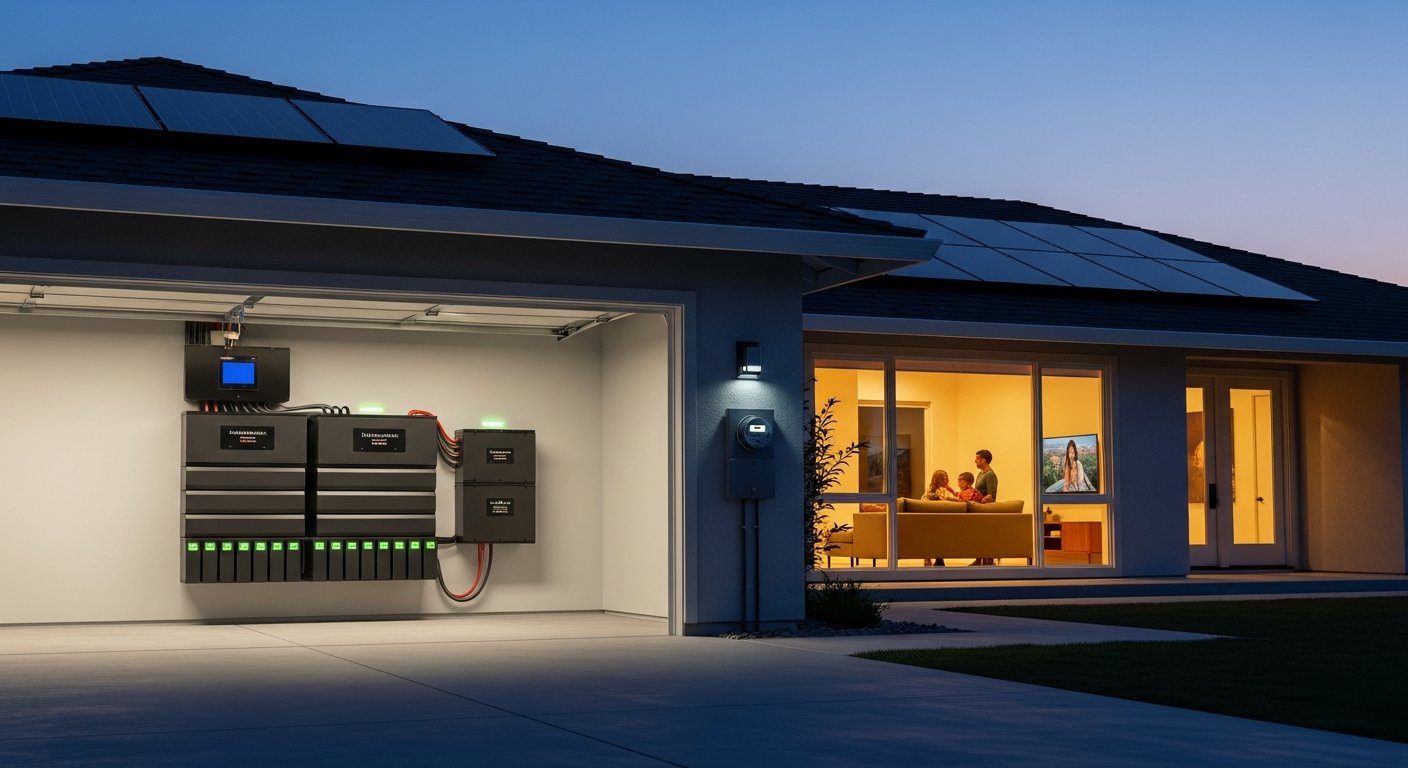
Solar Battery Storage: Cut Bills and Blackout Risk
A solar battery stores your excess solar energy for use after dark, cutting peak rate bills and keeping your home powered during outages.

By Alex Carter
Learn more about Solar Panel Installation and Repair for guides, costs, and what to expect.
Compare Solar Panel Installation and Repair Pros Near You

Enter your ZIP code to compare top-rated local professionals and request free quotes.
When the sun drops below the horizon, a standard solar panel system stops generating electricity. For decades, that meant solar homes still relied on the grid every single night. Solar battery storage has changed that equation. By pairing panels with a battery, you can store excess daytime energy and use it after dark, during peak rate hours, or when the grid goes down. This guide explains how solar batteries work, what they cost, and how to decide if one belongs on your property.
What a Solar Battery Actually Does
A solar battery is a rechargeable energy storage system that captures surplus power produced by your solar panels. Instead of exporting that extra electricity to the grid for a small credit, you keep it on site and draw from it when your panels are not producing. This simple shift in energy timing creates two major benefits: lower utility bills and greater resilience.
Most modern solar batteries use lithium-ion chemistry, the same technology that powers electric vehicles and smartphones. They are compact, wall mounted, and require very little maintenance. A typical home battery stores between 10 and 15 kilowatt-hours (kWh) of usable capacity, which is enough to run essential appliances like refrigerators, lights, and Wi-Fi routers overnight or through a short outage.
You can also think of a battery as a buffer between your home and the utility grid. When rates spike during evening peak hours, you can discharge stored energy instead of buying expensive electricity. When the grid hiccups, your battery can power critical loads automatically. That combination of financial control and energy independence is why battery adoption is growing rapidly across the United States.
How a Solar Battery Saves You Money
The financial case for a solar battery depends heavily on your utility rate structure, but there are three clear ways a battery can reduce your annual energy costs.
1. Time-of-Use Rate Shifting
Many utilities now charge more for electricity during evening hours when demand is high. A battery lets you charge during the day when rates are low and discharge in the evening when rates are high. This practice, called load shifting or arbitrage, can shave 30 to 50 percent off your electricity bill in areas with steep peak rates, such as California and parts of Arizona.
2. Increased Self-Consumption
Without a battery, solar panels often send 30 to 50 percent of their generated power back to the grid. Depending on your net metering policy, that exported electricity may be credited at a low wholesale rate. By storing that energy and using it on site, you effectively value every kilowatt-hour at your full retail rate. This is particularly valuable in states where net metering compensation has been reduced, like Florida and Texas.
3. Backup Power and Outage Avoidance
While not a direct monthly savings, having backup power protects you from spoiled food, lost work hours, and hotel costs during outages. In regions with frequent storms or grid instability, a battery can pay for itself through avoided disruption. Some utilities even offer demand response programs that pay you for allowing them to draw from your battery during peak events, adding another revenue stream.
To estimate your specific savings, NewSolarQuotes provides a free solar and battery cost calculator that factors in your utility rates, location, and energy usage. You can also request no obligation quotes from certified installers in your area to compare system designs and prices.
Solar Battery Cost and Payback Period
The upfront cost of a solar battery is still the biggest barrier for many homeowners. In 2026, the average installed price for a 10 kWh lithium-ion battery ranges from $10,000 to $16,000 before incentives. That price includes the battery unit, inverter (if not already integrated), wiring, permits, and labor. The final cost varies by brand, installation complexity, and whether you are retrofitting an existing solar system or installing panels and battery together.
Payback periods typically range from 6 to 12 years, depending on your utility rates and how often you cycle the battery. To improve the economics, consider these factors:
- Federal tax credit: The 30 percent Investment Tax Credit applies to battery installations, even when added to an existing solar system, as long as the battery is charged by solar.
- State and local rebates: Programs in California (SGIP), Massachusetts (SMART), and New York (NY-Sun) can reduce costs by $2,500 to $7,000.
- Utility incentives: Some utilities offer upfront rebates or performance payments for battery systems that participate in grid services.
Because incentives change frequently, verify current programs with your local utility or a trusted installer. NewSolarQuotes keeps its state incentive guides updated so you can see exactly what is available in your area.
Solar Battery vs. Generator: Which Is Better?
When homeowners think about backup power, they often compare batteries to gas generators. Both provide electricity during outages, but they differ significantly in cost, convenience, and environmental impact. Generators are cheaper to install upfront ($3,000 to $8,000 for a whole home unit), but they require fuel, regular maintenance, and they emit noise and fumes. Batteries are silent, clean, and require almost no upkeep, but they have a higher initial cost and limited backup duration.
For most solar owners, a battery is the better long term investment because it saves money every day, not just during emergencies. A generator sits idle until an outage, while a battery actively reduces your electricity bill all year. If you live in an area with frequent long outages, you can pair a battery with a smaller generator as a hybrid solution, using the generator only to recharge the battery during extended grid failures.
Key Factors to Consider Before Buying
Before you commit to a solar battery, evaluate your home's energy profile and your goals. Not every home needs a battery, and installing one without a clear purpose can extend your payback period unnecessarily. Here are the most important questions to answer:
- What is your primary goal? If you want backup power, prioritize a battery with high surge capacity and a reliable transfer switch. If you want bill savings, focus on usable capacity and cycle life.
- Do you have net metering? Under full retail net metering, a battery rarely makes financial sense because the grid acts as your storage for free. In states with reduced or no net metering, batteries become much more valuable.
- What is your utility rate structure? Check if your utility charges time-of-use rates. If not, a battery may only provide value through backup protection.
- What is your average daily usage? A typical home uses 30 kWh per day. If you only want to cover your fridge and lights, a smaller 5 to 8 kWh battery may suffice. For whole home backup, you may need 15 to 20 kWh or more.
- Will you be installing panels at the same time? Bundling a battery with a new solar installation is often cheaper than retrofitting later because the installer can size the inverter and wiring accordingly.
Take time to get multiple quotes and compare system designs. A reputable installer will walk you through these questions and recommend a battery size that matches your needs without overselling.
How to Choose the Right Solar Battery
All solar batteries are not created equal. The best battery for your home depends on your budget, available space, and what you want the battery to do. When comparing models, focus on these specifications:
- Usable capacity (kWh): The amount of energy you can actually draw from the battery. Ignore total capacity because some reserves are kept to protect battery health.
- Power output (kW): How much electricity the battery can deliver at once. This determines which appliances it can start, especially those with motors.
- Round trip efficiency: The percentage of energy that comes out versus what goes in. Most lithium-ion batteries achieve 90 to 95 percent.
- Warranty and cycle life: Look for a warranty that guarantees at least 70 percent capacity after 10 years or 10,000 cycles.
Popular brands like Tesla Powerwall, Enphase IQ, LG Chem, and Sonnen offer different trade offs between cost, capacity, and smart features. Rather than fixating on a single brand, ask your installer to recommend a model based on the brand that is most reliable in your region and compatible with your existing solar inverter.
Installing a Solar Battery: What to Expect
Once you choose a battery, the installation process usually takes one to two days. The installer begins by inspecting your electrical panel and solar system to confirm compatibility. They then mount the battery on a wall, typically in a garage, basement, or exterior wall. Next, they connect the battery to your solar inverter and electrical panel, install a transfer switch or subpanel for critical loads, and configure the software to match your utility rate schedule.
After installation, the local utility may need to inspect the system and approve interconnection. This process can take anywhere from a few days to a few weeks, depending on your city and utility. During this period, your battery will operate in a limited mode. Once approved, you can start using the battery to shift your energy use and protect against outages. Many batteries include a companion app that shows real time charging and discharging, which helps you understand your energy patterns and fine tune settings.
Maintenance and Lifespan
One of the main advantages of a solar battery is its low maintenance. Unlike generators, there is no oil to change, no fuel to store, and no engine to tune. The only regular task is checking the app or panel display to ensure the battery is charging and discharging as expected. You should also keep the area around the battery free of dust and debris to allow proper ventilation.
Most lithium-ion batteries are designed to last 10 to 15 years, which is slightly shorter than the 25 year lifespan of solar panels. Over time, the battery's capacity gradually degrades, meaning it will store less energy than when it was new. A typical warranty guarantees that the battery will retain at least 70 percent of its original capacity after 10 years. At the end of its useful life, the battery can be recycled, and many manufacturers have take back programs.
To maximize your battery's lifespan, avoid fully draining it on a regular basis. Most systems have software that automatically stops discharging at a safe state of charge, usually around 10 to 20 percent. You can also set the battery to prioritize solar charging, which reduces cycling and extends its life.
Battery Incentives and the Future of Home Storage
The cost of solar batteries has fallen by nearly 80 percent over the past decade, and the trend is expected to continue as manufacturing scales up. At the same time, more utilities are moving to time-of-use rates and reducing net metering credits, which makes batteries more financially attractive. Many state and local governments are also adding incentives specifically for energy storage, recognizing that batteries help stabilize the grid and reduce the need for new power plants.
Looking ahead, expect batteries to become more integrated with smart home systems. They will automatically trade energy with the grid when prices are favorable, charge your electric vehicle during low rate hours, and participate in demand response programs that pay you for shifting your load. Some utilities are even piloting virtual power plants, where thousands of home batteries are aggregated to provide grid services, with homeowners earning credits or payments for participating.
If you are already planning a solar installation, adding a battery at the same time is often the most cost effective approach. If you already have solar panels, a battery can be retrofitted in most cases. Either way, now is a strong time to explore solar battery storage, especially if your utility rates are rising or you live in an area prone to outages.
Ready to see how a solar battery can lower your bills and protect your home? Use NewSolarQuotes to compare certified installers and receive up to three free quotes tailored to your energy needs. The process takes less than two minutes and puts you in control of your energy future.
Learn more about Solar Panel Installation and Repair for guides, costs, and what to expect.
Compare Solar Panel Installation and Repair Pros Near You
Enter your ZIP code to compare top-rated local professionals and request free quotes.