
Solar Carport vs Ground Mount vs Rooftop for Business
Compare solar carport vs ground mount vs rooftop for business properties and find the best fit. Call 8332123715 for expert guidance and free quotes.

By Julia Walsh
Learn more about Solar Panel Installation and Repair for guides, costs, and what to expect.
Compare Solar Panel Installation and Repair Pros Near You

Enter your ZIP code to compare top-rated local professionals and request free quotes.
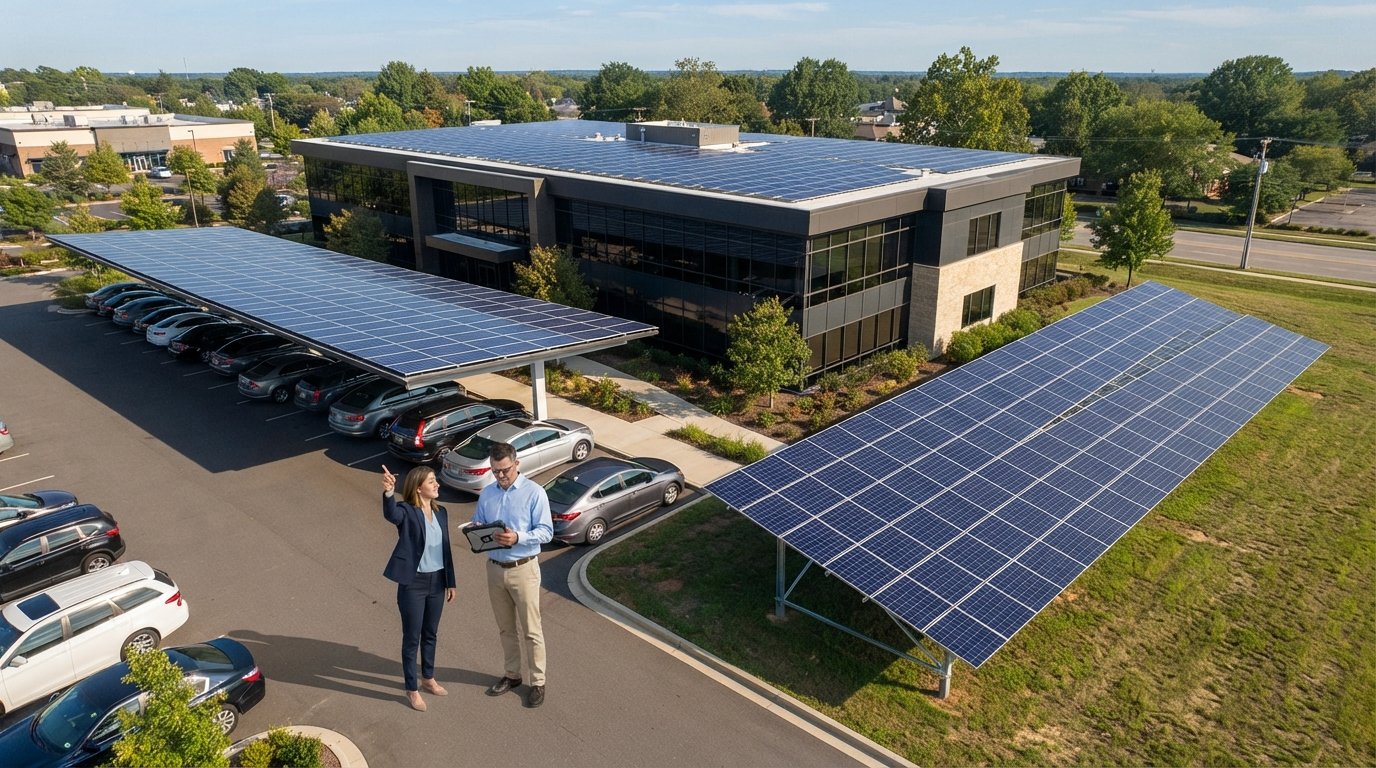
Choosing where to put solar panels on a business property is one of the first decisions that shapes your project budget, timeline, and long-term return. You can mount an array on the roof, anchor it to open land, or build a solar carport over your parking lot. Each option carries a different cost profile, structural requirement, and revenue story. For a business owner weighing solar carport vs ground mount vs rooftop for business properties, the right answer depends less on which technology is best in the abstract and more on your site, your power load, and your financing strategy. This guide breaks down the tradeoffs so you can move into the quoting phase with clear priorities instead of guesswork.
Why Placement Drives Your Business Solar ROI
Solar panels generate the same electricity regardless of where they sit, but the economics change dramatically with placement. A rooftop system reuses an existing structure, so you avoid land costs and new foundations. A ground mount gives you total control over tilt and orientation, which can lift production per panel. A solar carport produces power while also shading vehicles, and it can turn underused pavement into an asset. The placement decision affects installation labor, permitting complexity, structural engineering, available incentives, and even how easily you can expand later.
It also affects how quickly you reach payback. Businesses typically evaluate solar on simple payback, internal rate of return, and cash flow under a power purchase agreement or loan. A cheaper installation with slightly lower production can beat a premium installation with peak output if the premium pushes payback past your tolerance. That is why comparing these three options on a single spreadsheet, using your own electricity rates and usage profile, matters more than any generic ranking.
Before you compare structures, it helps to understand how canopies and parking structures are engineered and priced. Our guide on solar carport and canopy structures for parking areas walks through the design basics, so you can evaluate carport bids with more confidence.
Rooftop Solar for Commercial Buildings
Rooftop solar is usually the default choice for businesses because it leverages square footage you already own and maintain. If your building has a large, unobstructed roof with at least 15 to 20 years of useful life remaining, rooftop mounting often delivers the lowest installed cost per watt. There is no land acquisition, no separate foundation, and often no additional fencing or security. The array sits above the building envelope, and in some cases it can slightly reduce cooling loads by shading the roof surface.
The constraints are structural and practical. Older roofs may need reinforcement, replacement, or re-covering before panels go down, because removing and reinstalling an array later is expensive. Roof penetrations for mounting hardware create potential leak points that must be flashed correctly. Shading from HVAC units, vents, parapets, and neighboring buildings can drag down production, and irregular roof shapes waste usable area. Fire code setbacks and access pathways further reduce the array footprint on many commercial roofs.
Rooftop solar also competes with other roof uses. If you plan to add equipment, skylights, or a green roof, a 25-year solar commitment may conflict. Still, for warehouses, manufacturing plants, retail centers, and office buildings with sound roofs and heavy daytime loads, rooftop is often the fastest path to savings. A qualified installer will assess structural capacity, roof warranty terms, and interconnection options before quoting, and NewSolarQuotes can connect you with vetted local professionals who handle that evaluation as part of the bid process.
Ground Mount Solar for Commercial Sites
Ground mount systems shine when you have usable land and want maximum design freedom. Because the racking sits on engineered foundations rather than your roof, you can set the ideal tilt and azimuth for your latitude, space rows to minimize shading, and orient panels for the production curve that best matches your utility rate structure. Ground mounts are also easier to maintain and expand: adding panels later is a matter of extending racking rather than re-engineering a roof.
The tradeoffs are land use and site work. You need enough acreage, typically several acres per megawatt depending on row spacing and panel efficiency, plus geotechnical work, trenching for conduit, access roads, and often fencing and screening. Permitting and environmental review can take longer than a rooftop project, and land that could be used for parking, storage, or future construction now carries a long-term energy commitment. In some jurisdictions, ground mount arrays on prime agricultural land face additional scrutiny.
Ground mounts make the most sense for businesses with surplus land, rural or industrial sites, or properties where the roof cannot support solar. They are also common when a company wants a larger array than the building can host, or when the owner wants a visible, ground-level demonstration of sustainability. If your site qualifies, a ground mount can deliver the highest energy yield per panel of the three options, which matters when every kilowatt-hour offsets a high commercial rate.
Solar Carports: Turning Parking Into Power
Solar carports occupy a middle ground that is increasingly popular for businesses with large parking lots. The structure serves two purposes: it shades vehicles and generates electricity above the parking stalls. For campuses, retail centers, hospitals, airports, and office parks, a carport can monetize pavement that otherwise produces nothing. It also improves the customer or employee experience by protecting cars from sun, hail, and snow, which can be a genuine amenity in hot and cold climates alike.
Carports cost more per watt than rooftop or ground mount because you are paying for steel, foundations, and engineering in addition to the solar equipment. However, they can unlock solar on sites where the roof is unsuitable and land is unavailable or too valuable to dedicate to energy production. They also preserve the surface below for parking, so you are not choosing between cars and kilowatts. In some markets, carports qualify for the same federal investment tax credit as other solar assets, and accelerated depreciation can improve the after-tax return.
Design details matter. Clearance height, snow load, wind uplift, drainage, lighting, and EV charger integration all affect cost and functionality. A carport that also supports EV charging can attract tenants and customers while future-proofing the property. Because carports are highly visible, they double as a marketing asset, signaling sustainability commitments to stakeholders and the public. Businesses comparing solar carport vs ground mount vs rooftop for business properties often find that carports win on visibility and dual use, even when the raw cost per watt is higher.
Comparing Cost, Output, and Complexity
To make a sound decision, compare the three options across the variables that drive your financial model. The table below summarizes typical differences, but your installer's site-specific numbers should replace these general patterns.
- Installed cost per watt: Rooftop is usually lowest, ground mount is moderate, and carport is highest due to structural steel and foundations.
- Energy production per panel: Ground mount often leads because of optimal tilt and spacing, carport is competitive, and rooftop varies with orientation and shading.
- Site requirements: Rooftop needs a sound roof and structural capacity, ground mount needs land and site work, and carport needs an appropriate parking area and clearance.
- Permitting and timeline: Rooftop is often fastest, ground mount can face land-use review, and carport combines structural and electrical permits.
- Dual-use value: Carport provides shade and EV charging potential, rooftop provides no additional function, and ground mount uses land that may have other value.
Beyond the headline numbers, consider operations and maintenance. Rooftop arrays can be harder to access for cleaning and repairs, especially on tall buildings. Ground mounts are easy to service but may need vegetation management. Carports require periodic inspection of both the structure and the modules, and snow removal may be necessary in northern climates. Financing also differs: third-party ownership and power purchase agreements are common for all three, but lenders may view carports and ground mounts differently because of collateral and real estate considerations.
Finally, think about expansion and exit. If you might sell the property, a rooftop array transfers with the building and can add value, while a ground mount on leased land may complicate the sale. Carports are typically permanent structures that stay with the property and can be marketed as an amenity. Understanding these dynamics early helps you avoid a system that saves money on energy but creates friction at sale or refinance.
How to Choose the Right Option for Your Property
Start with a site assessment that answers three questions: How much unobstructed roof area do you have, and what condition is the roof in? Do you have land that is not needed for core operations, and is it zoned for energy use? Do you have a parking area large enough to host a carport without disrupting traffic flow? The answers will quickly narrow your options. If the roof is sound and large, rooftop likely wins on cost. If the roof is compromised but you own open land, ground mount may be the better path. If you have neither roof space nor land but do have parking, a carport can be the only viable route to onsite generation.
Next, model the financials with realistic inputs. Use your actual utility rate schedule, including demand charges if applicable, and account for federal and state incentives, depreciation, and any local rebates. Compare payback, cash flow, and net present value under each scenario. Do not assume that the cheapest installation is the best investment; a slightly higher upfront cost can deliver better long-term returns if production or incentives favor it. If you prefer to avoid capital outlay, explore power purchase agreements and leases, which shift the upfront cost to a third party in exchange for a lower electricity rate.
Then, get multiple quotes from experienced commercial installers. The same project can be priced very differently depending on engineering assumptions, equipment selection, and financing terms. NewSolarQuotes is an independent educational resource that helps businesses compare options and connect with certified installers for free, no-obligation quotes. You can also explore broader guidance and resources on free solar power quotes to understand how the quote process works and what to ask before you sign.
As you evaluate proposals, ask each installer to explain their assumptions about production, degradation, maintenance, and incentives. A good proposal will show you the math, not just the total. Request references from similar commercial projects and confirm that the installer has experience with your chosen mounting type. If you are considering a carport, ask about structural warranties and EV charger readiness. If you are considering a ground mount, ask about land prep, fencing, and interconnection timelines.
Key Takeaways for Business Owners
There is no universal winner in the solar carport vs ground mount vs rooftop for business properties debate. Rooftop solar usually offers the lowest cost and fastest deployment when the building is structurally ready. Ground mount solar delivers the most design flexibility and often the highest production when land is available. Solar carports cost more but unlock solar on constrained sites and add shade, visibility, and EV charging potential. The best choice is the one that matches your site conditions, energy goals, and financial targets.
Whichever route you take, start with a professional site assessment, compare multiple quotes, and pressure-test the assumptions behind each proposal. With the right structure and financing, commercial solar can cut operating costs, hedge against rate increases, and strengthen your sustainability profile for years to come.