
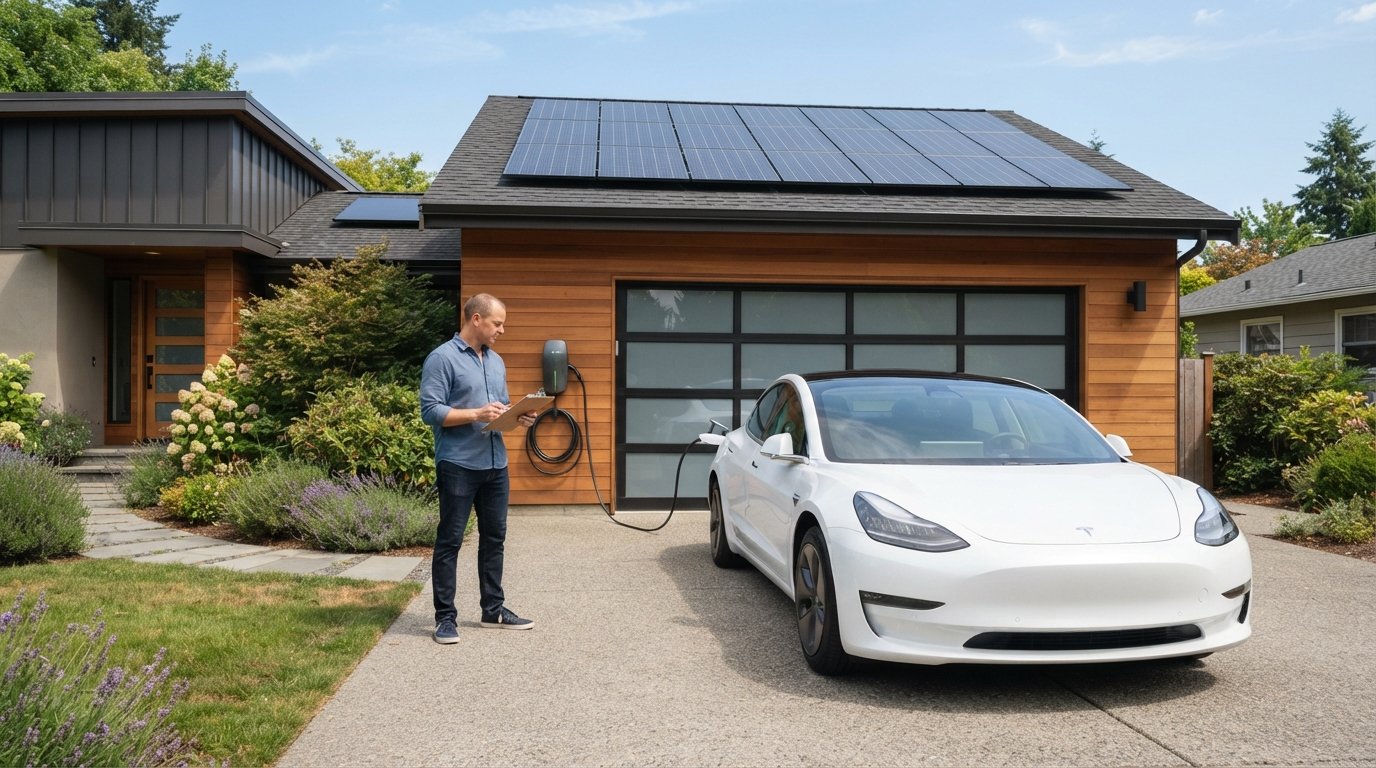
Solar Plus Electric Vehicle Charging Setup Planning
Plan your solar plus electric vehicle charging setup to maximize savings. Call (833)-212-3715 for expert guidance and free quotes.

By Amelia Griffin
Learn more about Solar Panel Installation and Repair for guides, costs, and what to expect.
Compare Solar Panel Installation and Repair Pros Near You

Enter your ZIP code to compare top-rated local professionals and request free quotes.
Electric vehicles are no longer a niche purchase; they are a mainstream choice for drivers who want to cut fuel costs and emissions. But charging that EV from the grid can erase some of the savings, especially if you live in an area with high electricity rates. Pairing solar panels with a home EV charger solves that problem, turning sunlight into miles and locking in a lower cost per mile for years. The catch is that solar plus electric vehicle charging setup planning requires more than buying panels and plugging in a car. You need to size the system correctly, place the charger wisely, and understand how incentives stack. This guide walks you through the key decisions so you can build a setup that actually pays off.
Why Planning Solar and EV Charging Together Matters
Adding solar first and then realizing you need more capacity for an EV is an expensive mistake. The same goes for installing a charger that cannot handle your daily driving needs or a panel that cannot support the extra load. When you plan both together, you can optimize for cost, performance, and future growth. According to the U.S. Department of Energy, the average EV consumes about 4,000 kWh per year, which is roughly a third of a typical home's electricity use. That extra load directly affects how many solar panels you need.
Planning also helps you take advantage of incentives that reward combined installations. Some states and utilities offer rebates for EV chargers, and the federal tax credit for solar can be applied to certain upgrade costs when they are part of the solar project. By thinking ahead, you avoid missing out on these savings. Moreover, a well-designed system can future-proof your home for a second EV or battery storage, saving you from costly retrofits later.
Sizing Your Solar System to Offset EV Charging Load
The first step in solar plus electric vehicle charging setup planning is calculating how much additional solar capacity you need. Start with your driving habits: estimate annual miles and divide by the EV's efficiency (miles per kWh). For example, 12,000 miles at 3 miles per kWh equals 4,000 kWh per year. Then add that to your home's current annual electricity usage. A solar installer will use this total to size the system, but you can get a rough idea by using a solar calculator or reviewing past utility bills.
Keep in mind that solar production varies by location and season. In sunny states like Arizona or California, a 1 kW solar array might produce 1,600 kWh per year, while in less sunny regions it could be 1,200 kWh. To offset 4,000 kWh of EV charging, you might need 2.5 to 3.3 kW of additional solar capacity. However, if you plan to charge mostly at night, you will either need battery storage or rely on net metering to bank credits. We will cover that later.
It is also wise to oversize slightly for future needs. Many households add a second EV or increase driving over time. A good rule of thumb is to add 10-20% extra capacity to accommodate degradation and future loads. Your installer can run a simulation to find the sweet spot between cost and offset.
Level 2 Charger Placement and Electrical Panel Upgrades
A Level 2 charger (240-volt) is essential for overnight charging and can add 20-30 miles of range per hour. Proper placement makes daily use convenient and safe. Consider these factors:
- Parking location: The charger should be near where you park, ideally within 25 feet to minimize cable runs and voltage drop.
- Weather protection: If mounting outdoors, choose a NEMA 3R or 4 rated charger and mount it under a canopy if possible.
- Electrical panel capacity: Most homes have 100-amp or 200-amp service. A 40-amp Level 2 charger draws about 32 amps continuously, which may require a panel upgrade if your service is already maxed out.
- Permitting: Many jurisdictions require a permit for charger installation, and some have specific requirements for disconnects or GFCI protection.
Before finalizing the charger location, have an electrician assess your panel. Upgrading from 100 to 200 amps can cost $1,500 to $3,000, but it may be necessary to support both the EV charger and other large appliances. If you are adding solar, the inverter and main panel must also be compatible. A load calculation will determine if you need a service upgrade or if a smart charger with load management can avoid it.
For businesses planning fleet charging, the considerations are similar but at a larger scale. Our guide on solar plus EV charging for business fleets covers demand charges and multi-port setups in detail.
Scheduling Charging to Align with Solar Production
If you work from home or have a flexible schedule, you can charge your EV during the day when solar production is highest. This maximizes self-consumption and reduces reliance on the grid. Many smart chargers and EV apps allow you to set charging times. For example, you can schedule charging from 10 a.m. to 3 p.m. when the sun is strong. This is especially beneficial if your utility has time-of-use (TOU) rates with higher prices in the evening.
For those who commute during the day, overnight charging is more practical. In that case, you will need either net metering or battery storage to use solar energy at night. Net metering policies vary by state; some credit you at the full retail rate, while others pay a lower avoided-cost rate. Check with your utility to understand how credits work. If net metering is weak, a home battery becomes more attractive.
Another strategy is to use a dual-port charger or two chargers if you have multiple EVs, and stagger charging to avoid exceeding solar production. Smart load management systems can automatically adjust charging power based on available solar excess.
Battery Storage and Overnight Charging
Battery storage allows you to store excess solar energy during the day and use it to charge your EV at night. This is particularly valuable if you have TOU rates with high evening prices or if net metering is unfavorable. A typical home battery has 10-13 kWh of usable capacity, which can provide 30-40 miles of EV range. That may be enough for daily commuting, but if you drive more, you might need multiple batteries or a larger system.
When planning battery storage, consider the following:
- Capacity: Match battery size to your typical overnight charging needs plus critical loads during outages.
- Power rating: Ensure the battery can deliver enough power to charge your EV and run other appliances simultaneously.
- Incentives: The federal tax credit covers 30% of battery costs when installed with solar, and some states offer additional rebates.
- Future expansion: Choose a modular system that allows you to add capacity later.
Battery storage also provides backup power during grid outages, which is a nice bonus for EV owners who want resilience. However, it adds cost, so weigh the benefits against your charging patterns and utility rates.
Incentives for Solar and EV Chargers
Several financial incentives can reduce the cost of your solar plus EV charging setup. The federal residential clean energy credit (often called the solar tax credit) covers 30% of solar panel costs and can also apply to battery storage. For EV chargers, the alternative fuel vehicle refueling property credit (30C) offers up to $1,000 for residential installations in eligible areas, but it has expired and been extended multiple times; check current status. Many states and utilities offer rebates for Level 2 chargers, sometimes $500 or more.
Additionally, some states offer sales tax exemptions for solar equipment and property tax abatements. Utilities may have demand response programs that pay you to charge during off-peak times. Combining these incentives can significantly lower your upfront cost. Be sure to verify eligibility and paperwork requirements, as some programs require installation by a certified contractor.
When you request quotes through NewSolarQuotes, our network of certified installers can help you navigate available incentives and ensure you maximize savings.
Step-by-Step Planning Process
To tie it all together, here is a practical sequence for planning your solar plus EV charging setup:
- Assess your driving habits and calculate annual EV electricity consumption.
- Review your home's electrical panel capacity and plan for any upgrades.
- Determine the best location for the Level 2 charger, considering convenience and wiring costs.
- Size the solar system to offset both home and EV usage, factoring in future growth.
- Decide whether battery storage is needed for overnight charging or backup power.
- Research available incentives and choose qualified installers.
- Obtain multiple quotes and compare system designs and warranties.
- Schedule installation and set up charging schedules to maximize solar self-consumption.
Following these steps will help you avoid common pitfalls and create a system that delivers maximum savings and convenience. If you are also planning a move, resources like Moving.Homes offer checklists and guides to coordinate home upgrades with your relocation, ensuring your solar and EV setup is ready when you arrive.
Common Pitfalls to Avoid
Even with good intentions, some homeowners make mistakes that reduce the benefits of their solar plus EV setup. One common error is undersizing the solar array because they underestimate future driving or forget to account for panel degradation. Another is skipping the electrical panel upgrade, leading to frequent tripped breakers or the need for costly retrofits. Not understanding net metering rules can also lead to disappointment when credits are lower than expected.
Finally, some homeowners forget to factor in the cost of permits and inspection fees, which can add several hundred dollars. By planning ahead and working with experienced professionals, you can avoid these issues and enjoy a seamless transition to solar-powered driving.
Ready to take the next step? Request free quotes from certified installers in your area and start your solar plus electric vehicle charging setup planning today.
Learn more about Solar Panel Installation and Repair for guides, costs, and what to expect.
Compare Solar Panel Installation and Repair Pros Near You
Enter your ZIP code to compare top-rated local professionals and request free quotes.