
Best Solar Inverters for Home Systems: 2026 Buyer Guide
Compare string, micro, and hybrid inverters on efficiency, warranty, and battery readiness. Call (833)-212-3715 for expert guidance on your home solar system.

By Caleb Hayes
Learn more about Solar Panel Installation and Repair for guides, costs, and what to expect.
Compare Solar Panel Installation and Repair Pros Near You

Enter your ZIP code to compare top-rated local professionals and request free quotes.
Your solar panels get all the glory, but the inverter is the component that actually turns sunlight into usable electricity and keeps your system running safely. Choosing the wrong inverter can cost you efficiency, warranty coverage, and future battery options. This buyer guide cuts through the marketing claims and shows you how to compare string, micro, and hybrid inverters on the metrics that matter for a home system.
Why the Inverter Deserves More Attention Than the Panels
Panels are passive. They sit on your roof and generate direct current (DC) for decades with minimal maintenance. Inverters are active power electronics that convert DC to alternating current (AC) for your home, synchronize with the grid, and manage safety shutdowns. They work harder, generate heat, and are the most likely component to fail first.
That reliability gap matters because inverter replacement can cost $1,500 to $3,000 in parts and labor. A 25-year panel warranty means little if your inverter dies in year 12 and the replacement warranty only covers the unit, not the labor. When you compare proposals, treat the inverter warranty as seriously as the panel warranty.
Inverter choice also shapes your roof layout, your battery readiness, and how much energy you harvest on cloudy days or under partial shade. A cheap inverter can erase 5 to 15 percent of your system's production over its lifetime. That is why this guide focuses on the three main categories and the specific questions to ask installers.
String, Microinverter, and Hybrid Inverters Compared
Most residential systems use one of three architectures. Each has distinct tradeoffs in cost, shade tolerance, monitoring, and battery compatibility.
String Inverters (Central Inverters)
A string inverter takes DC power from a series of panels and converts it in one central unit, usually mounted near your main electrical panel. It is the most cost-effective option, typically $1,000 to $2,000 for the inverter itself, and it is easy to service because the unit is at ground level.
The downside is shade sensitivity. Panels in a string are wired in series, so a shaded panel can drag down production for the whole string. String inverters also have limited monitoring: you see system-level output, not panel-level performance. If one panel underperforms, you may not know which one without manual testing.
Microinverters
Microinverters mount under each panel and convert DC to AC right at the module. This design eliminates the single point of failure, improves performance under partial shade, and provides panel-level monitoring through a app. It also simplifies roof layout because panels can face different directions without string mismatch losses.
The tradeoff is cost. Microinverters typically add $0.10 to $0.20 per watt, which can mean $800 to $1,600 more for a 8 kW system. They also sit in harsh roof conditions (heat, moisture, thermal cycling), and while warranties are often 25 years, labor for replacement can be significant if access is difficult.
Hybrid Inverters
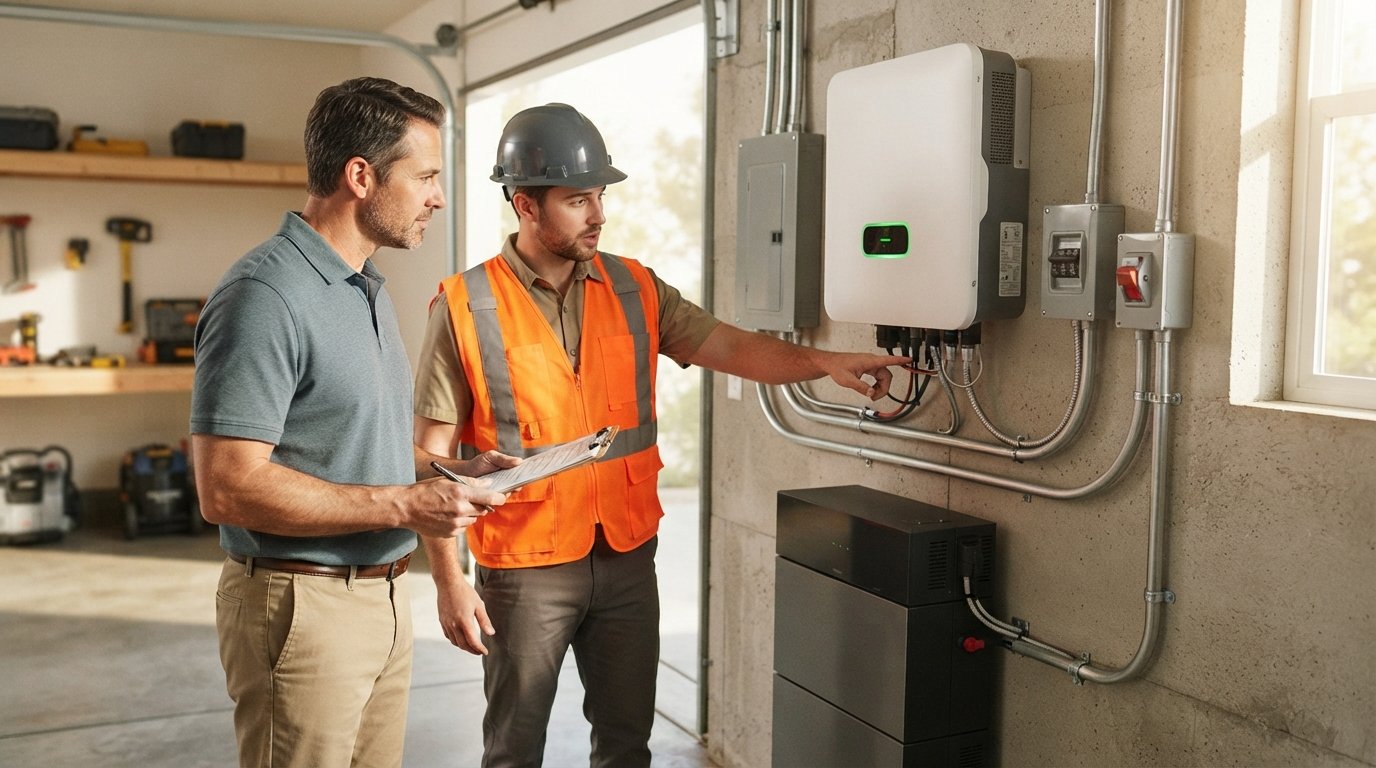
Hybrid inverters combine a string inverter with battery charge controllers and transfer switches in one unit. They are the go-to choice if you plan to add storage now or later. A hybrid inverter can manage solar production, battery charging, grid export, and backup loads without separate battery inverter hardware.
Hybrids are less standardized than pure string or micro solutions, and compatibility with battery brands varies. Some hybrids only work with specific battery chemistries or communication protocols. If you want flexibility, confirm the inverter supports open standards or at least two battery brands you trust.
Efficiency, Warranty, and Monitoring Differences That Matter
Efficiency ratings for residential inverters cluster between 96 and 99 percent. A 1 to 2 percent difference sounds small, but over 25 years it can add up to several hundred kilowatt-hours. More important than peak efficiency is part-load efficiency, because inverters rarely run at full rated output. Look for a weighted efficiency curve, not just a headline number.
Warranty terms vary more than efficiency. Standard string inverters often carry 10 to 12 year warranties, with extensions to 20 or 25 years available for a price. Microinverters commonly offer 25 years. Hybrid inverters usually land at 10 to 15 years. Always ask whether the warranty covers labor and shipping, and who honors it if the manufacturer exits the market.
Monitoring is where homeowner experience diverges. Basic string inverters may only show total production. Microinverters and many hybrids offer panel-level data, alerts for underperformance, and integration with home energy apps. If you travel or want to catch issues early, panel-level monitoring is worth the premium. It also helps installers diagnose problems remotely, which can shorten service visits.
Here are the key comparison points to put in a spreadsheet when you review proposals:
- Architecture: string, micro, or hybrid; how it handles shade and panel mismatch
- Efficiency: CEC weighted efficiency and part-load performance
- Warranty: years, labor coverage, and manufacturer stability
- Monitoring: system-level vs panel-level, app quality, alerting
- Battery readiness: AC or DC coupling, supported battery brands, backup capability
Use those five rows to compare at least three inverter options side by side. The cheapest quote often hides weak warranty labor terms or limited monitoring, which can cost more in the long run.
How Inverter Choice Interacts With Battery Plans and Roof Layout
If you plan to add a battery within five years, your inverter decision today determines how easy and affordable that upgrade will be. AC-coupled systems use a separate battery inverter, which is flexible but adds equipment and losses. DC-coupled systems use a hybrid inverter and charge the battery directly, which is more efficient but locks you into compatible battery brands.
Roof layout matters too. Complex roofs with multiple orientations, dormers, or shading from trees favor microinverters or string inverters with DC optimizers. Simple south-facing roofs with no shade can use a plain string inverter and save money. If you have any shade between 9 a.m. and 3 p.m., ask for a production estimate with and without optimizers or microinverters.
Battery backup also changes the inverter sizing conversation. If you want to run critical loads during an outage, the inverter must support islanding and a backup panel. Not all hybrid inverters offer whole-home backup; some only support a subpanel. Clarify what loads you want backed up and confirm the inverter can handle the surge current of your well pump, air conditioner, or furnace.
For a deeper dive into commercial-grade inverter selection, our guide on best solar inverters for commercial installations covers three-phase equipment and larger-scale monitoring, which can inform residential choices when you want robust data and serviceability.
Questions to Ask Installers When Comparing Inverter Proposals
Installers often default to the inverter brand they know best, not necessarily the best fit for your roof or battery plans. Ask these questions to force a clear comparison and avoid surprises after signing.
- What is the CEC weighted efficiency and the warranty labor terms? A 25-year warranty that excludes labor is worth less than a 15-year warranty with labor included.
- How does this inverter handle partial shade and panel mismatch? Ask for a production estimate with and without optimizers or microinverters.
- What battery brands and backup configurations are supported? Confirm AC or DC coupling, subpanel vs whole-home backup, and surge capacity.
- What monitoring is included, and who owns the data? Panel-level monitoring should be standard; data ownership and API access matter for smart home integration.
- What is the replacement process and expected lead time? Ask how long a warranty replacement takes and whether the installer provides a loaner or labor credit.
Write the answers down and compare them across quotes. If an installer cannot answer the battery compatibility question, that is a red flag for future upgrades. If they cannot provide a shade-adjusted production estimate, you may be overpaying for a system that underperforms.
One more practical tip: ask for the inverter's datasheet and warranty document, not just a brochure. The datasheet lists efficiency curves, temperature derating, and communication options. The warranty document reveals exclusions and labor coverage. Five minutes with those two PDFs can save you thousands later.
Matching Inverter Choice to Your Home and Energy Goals
The best inverter for your home depends on three factors: roof complexity, battery ambition, and budget. A simple, unshaded roof with no battery plans favors a high-quality string inverter with an extended warranty. A complex roof or partial shade favors microinverters or a string inverter with optimizers. A battery-ready home favors a hybrid inverter with confirmed battery compatibility.
Budget matters, but focus on total cost of ownership, not sticker price. Add the inverter cost, extended warranty cost, expected replacement labor, and monitoring value. A $1,500 string inverter that needs replacement in year 12 may cost more than a $2,500 hybrid that lasts 15 years and supports a battery later.
If you are also planning a move or renovation, keep your equipment documentation organized with your home records. Resources like Moving.Homes offer checklists for homeowners managing transitions, which can help you transfer warranty information and monitoring accounts to new owners.
Finally, get at least three quotes and ask each installer to justify the inverter choice in writing. The best solar inverters for home systems buyer guide is not about picking a brand name; it is about matching architecture to your roof, your battery plans, and your tolerance for service calls. With the right questions, you can choose an inverter that maximizes production and minimizes headaches for the next two decades.