
Solar Plus Battery vs Generator: Best Backup Power
Compare solar plus battery versus generator for power outages on cost, noise, and runtime. Call (833)-212-3715 for expert guidance.

By Amelia Griffin
Learn more about Solar Panel Installation and Repair for guides, costs, and what to expect.
Compare Solar Panel Installation and Repair Pros Near You

Enter your ZIP code to compare top-rated local professionals and request free quotes.
When the grid goes down, the difference between a dark, silent house and a warm, lit home comes down to one decision: how you plan to power through the outage. Homeowners today face a clear choice between solar plus battery versus generator for power outages, and the right answer depends on your budget, your climate, your noise tolerance, and how long you expect the grid to stay off. This comparison breaks down the real-world tradeoffs so you can choose a backup power strategy that fits your home and your family.
How Solar Plus Battery and Generator Backup Work
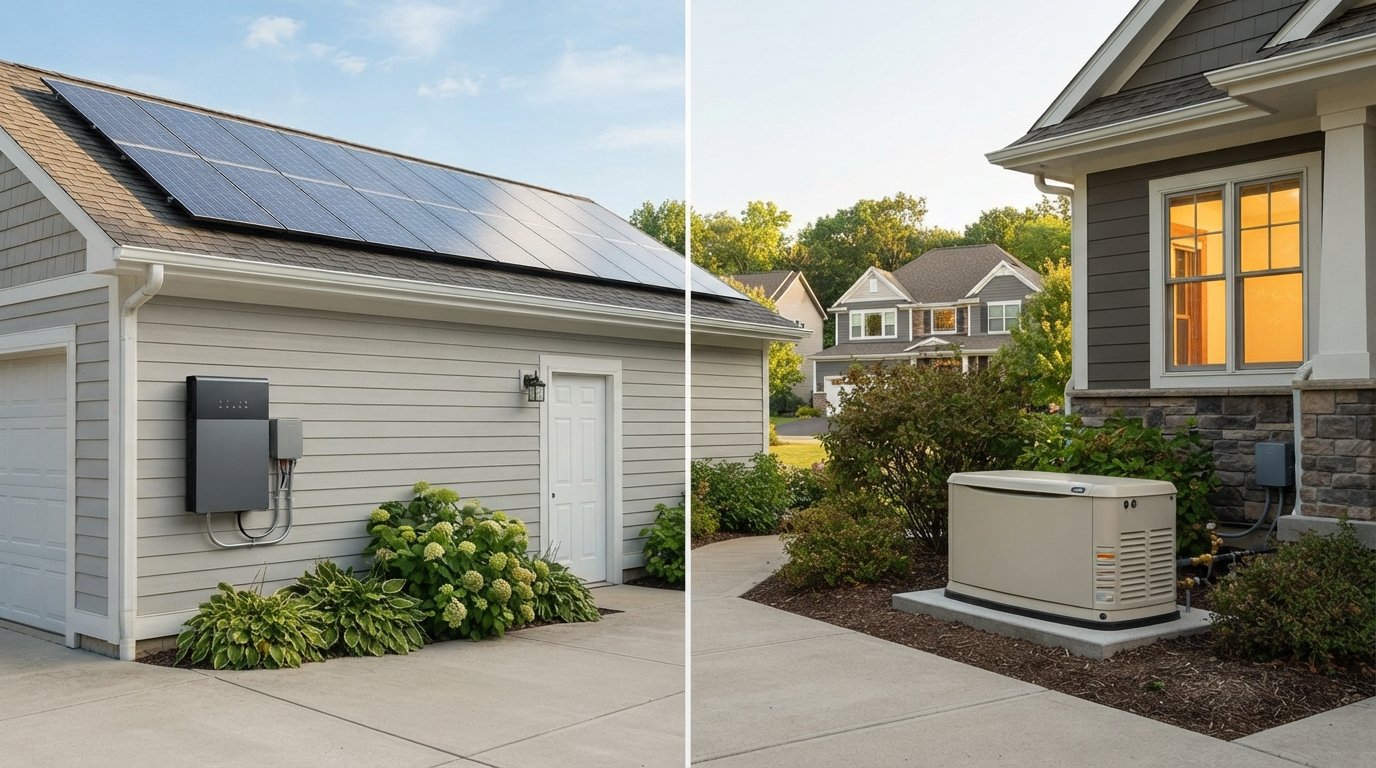
A solar plus battery system pairs photovoltaic panels with a rechargeable home battery, such as a lithium-ion unit mounted in the garage or on an exterior wall. During normal operation, the panels charge the battery and power your home. When an outage hits, the battery automatically disconnects from the grid and supplies electricity to a pre-selected set of circuits, often called critical loads. The key advantage is that the sun recharges the battery every day, so a well-sized system can ride through multi-day outages without any fuel deliveries.
A standby generator, by contrast, is a fossil-fuel engine (usually powered by natural gas, propane, or diesel) that kicks on within seconds of an outage. It can run for days as long as fuel is available, and it can power your entire home if sized correctly. Portable generators are a cheaper but manual alternative: you wheel them out, connect them to a transfer switch, and refuel them every few hours. The fundamental difference is that a battery stores energy, while a generator creates it on demand from fuel.
Understanding these mechanics matters because it shapes everything from installation cost to maintenance. If you are also planning to add electric vehicle charging to your solar setup, the sizing decisions for your battery and panels become even more important; our guide on solar plus EV charging system sizing explains how to balance those loads without overspending.
Cost Comparison: Upfront Price and Long-Term Expenses
The upfront cost is often the first thing homeowners compare, and the numbers are not close. A professionally installed whole-home standby generator typically runs $5,000 to $15,000 depending on capacity, fuel type, and electrical work. A portable generator costs $500 to $2,500 but offers far less convenience and capacity. A solar plus battery system, on the other hand, often costs $15,000 to $30,000 before incentives, though the solar panels themselves may already be part of your energy plan. The federal solar investment tax credit (currently 30 percent through 2032) can significantly reduce the net cost of the battery and panels.
Long-term expenses tell a different story. Generators require annual maintenance (oil changes, filter replacements, exercise runs) that typically costs $150 to $400 per year, plus fuel costs during extended outages. Propane and diesel prices fluctuate, and a long outage can mean hundreds of dollars in fuel. Batteries have no fuel costs and minimal maintenance, though their capacity degrades slowly over 10 to 15 years. When you factor in fuel savings and avoided maintenance, the lifetime cost of solar plus battery can be competitive, especially if you already have solar panels.
Here is a quick breakdown of the main cost differences:
- Upfront: Generators win on sticker price, but batteries qualify for tax credits.
- Fuel: Batteries use free sunlight; generators rely on propane, natural gas, or diesel.
- Maintenance: Generators need annual service; batteries need almost none.
- Lifespan: Generators last 10 to 20 years with care; batteries last 10 to 15 years.
For homeowners who already have solar or are planning to install it, adding a battery often makes more financial sense than buying a separate generator, because the battery leverages the solar investment you have already made. If you are still evaluating solar itself, requesting quotes from certified installers can help you see how battery costs fit into the overall picture.
Noise, Emissions, and Maintenance Differences
Generators are loud. A standby generator produces 60 to 70 decibels at close range, roughly the sound of a vacuum cleaner or a busy street. Portable generators can be even louder. In a quiet suburban neighborhood, that noise can annoy neighbors and disrupt sleep during a multi-day outage. Batteries, by contrast, are silent. They have no moving parts and produce zero emissions, which makes them safe to install indoors or in a garage (subject to code requirements).
Emissions are another differentiator. Gasoline and diesel generators produce carbon monoxide, a colorless and odorless gas that kills dozens of people every year when generators are run in enclosed spaces. Even natural gas standby generators produce nitrogen oxides and carbon dioxide. Batteries produce no direct emissions, and when charged by solar panels, they represent a clean backup solution. For families with young children, elderly members, or respiratory concerns, this is a meaningful advantage.
Maintenance is where batteries shine. A generator needs regular exercise (running under load for 20 to 30 minutes per month), oil changes, spark plug replacements, and fuel system checks. If you skip maintenance, the generator may fail when you need it most. A battery requires essentially no routine maintenance beyond occasional software updates and ensuring the vents stay clear. That reliability matters during a crisis, when a failed generator can leave you scrambling for alternatives.
How Long Each Option Powers Essential Loads
The duration question is critical, and the answer depends on how you size the system and what you consider essential. A typical home battery like a Tesla Powerwall or Enphase IQ Battery stores 10 to 13.5 kilowatt-hours of usable energy. If you power only essentials (refrigerator, lights, internet, phone charging, and a few outlets), that capacity can last 12 to 24 hours. If you include heating or cooling, the battery may last only 6 to 12 hours. However, solar panels recharge the battery every sunny day, so in a sunny climate, a solar plus battery system can sustain essentials indefinitely as long as the sun shines.
Generators have a different duration profile. A standby generator with a dedicated propane tank or natural gas line can run for days or weeks, limited only by fuel supply. Portable generators run 8 to 12 hours on a tank of gasoline, and refueling every few hours becomes a chore during extended outages. In rural areas where fuel deliveries may be delayed after a storm, a generator's dependence on fuel is a real vulnerability.
For a clearer picture, consider these scenarios:
- Short outage (2 to 6 hours): Both options handle essentials easily. A battery is quieter and automatic.
- One-day outage: A battery with solar recharge can last indefinitely in sunny weather; a generator runs fine if fuel is available.
- Multi-day outage (3 to 7 days): Solar plus battery wins in sunny climates; generators need a steady fuel supply, which may be disrupted.
- Week-long outage in cloudy weather: A generator with a large fuel tank is more reliable unless the battery system is oversized.
The takeaway is that solar plus battery excels in sunny regions with shorter outages, while generators offer predictable long-duration power as long as fuel is available. Many homeowners in hurricane-prone or wildfire-prone areas choose a hybrid approach, which we will explore next.
Combining Solar, Battery, and Generator for Tiered Backup
You do not have to choose one or the other. A growing number of homeowners are building tiered backup systems that combine solar panels, a home battery, and a generator. The battery handles short outages and daily energy management, the solar panels recharge the battery, and the generator kicks in only during extended outages or periods of low sunlight. This approach maximizes reliability while minimizing fuel consumption and noise.
Here is how a tiered system typically works:
- Tier 1 (battery): Instant, silent backup for essentials during short outages.
- Tier 2 (solar): Recharges the battery daily, extending coverage indefinitely in sunny conditions.
- Tier 3 (generator): Activates automatically if the battery drops below a set level, providing long-duration power.
This setup is especially valuable in regions with unpredictable weather. For example, a homeowner in the Northeast might rely on the battery for most outages but use a generator during a winter storm when snow covers the panels for days. The generator can also recharge the battery directly, acting as a backup charger. The upfront cost is higher, but the resilience is unmatched.
If you are considering a move to a new home and want to plan a backup system, resources like Moving.Homes offer practical checklists for evaluating a property's energy infrastructure before you buy. Understanding the electrical panel, fuel availability, and roof orientation can save you thousands in retrofit costs later.
Which Option Suits Urban, Suburban, and Rural Homes
The best backup power choice depends heavily on where you live. In dense urban areas, noise ordinances and space constraints often make generators impractical. A battery installed in a garage or on a wall is quiet, compact, and emissions-free, making it the clear favorite for city homeowners. Urban outages also tend to be shorter, which plays to the battery's strengths. If you live in an apartment or condo, a portable battery or a small solar plus battery setup may be your only option.
Suburban homes have more flexibility. A standby generator is feasible for many suburban properties, but neighbors may object to the noise during a long outage. A solar plus battery system is often the better lifestyle fit, especially if you already have solar panels or are considering them. The combination of solar and battery also reduces your carbon footprint, which appeals to environmentally conscious suburban homeowners. In areas with frequent but short outages, a battery alone may suffice.
Rural homes face the greatest reliability challenges. Grid outages can last days, and fuel deliveries may be delayed by downed trees or flooded roads. A generator with a large propane tank is a common choice, but a solar plus battery system with a generator backup offers the best of both worlds. Rural homeowners often have more roof space and land for solar panels, making it easier to size a system that covers essential loads. If you are in a wildfire-prone region, a battery paired with solar can keep your well pump and refrigerator running even when the grid is shut off for safety.
No matter where you live, the decision should start with an honest assessment of your essential loads, your budget, and your climate. Requesting quotes from certified installers is the most reliable way to get a system sized correctly for your home. You can also explore financing options that spread the cost over time, making a solar plus battery system more accessible than you might think.
Ultimately, solar plus battery versus generator for power outages is not a one-size-fits-all contest. Batteries win on quiet operation, zero emissions, low maintenance, and seamless integration with solar. Generators win on upfront cost and unlimited runtime as long as fuel is available. For many homeowners, the smartest path is a tiered system that combines both, delivering resilience without compromise. Start by understanding your outage patterns and your must-power loads, then choose the mix that keeps your home safe and comfortable when the grid goes dark.